


Plastic can persist for 20 to 1,000 years depending on the item and environment. In UK marine and landfill conditions, plastic bottles and disposable nappies take about 450 to 500 years to degrade, fishing lines can persist for around 600 years, and some single-use plastic materials in landfill can take up to 1,000 years to decompose.
By Alex Morgan
That range should change how policymakers frame the issue. The question isn't merely how long does it take plastic to degrade. The harder governance problem is that many plastics don't disappear in any meaningful sense. They fragment, spread, and remain in circulation as microplastics long after their original form is gone.
For G7 and G20 governments, that makes plastic waste a long-tail liability rather than a short-term disposal challenge. Waste systems are still organised around collection and treatment. But the evidence points to a different reality. Plastic discarded today can outlast multiple generations, and uncertainty about degradation pathways makes weak standards especially risky.
Table of Contents
- The Global Scale of Plastic Persistence
- Degradation vs Biodegradation A Critical Policy Distinction
- Plastic Degradation Timelines Across Key Environments
- Scientific Uncertainty and Measurement Challenges
- The Failure of Biodegradable Plastics in Real-World Conditions
- A Policy Roadmap for Multilateral Action
The Global Scale of Plastic Persistence
A household waste stream with geopolitical implications
The scale of plastic persistence becomes clearer when viewed through ordinary consumption. UK households discard an estimated 1.7 billion pieces of plastic packaging every week, equivalent to 90 billion pieces annually, and 79% of all plastic waste globally ends up in landfills or the natural environment, where it can persist for 20 to 500 years, according to Greenpeace UK's plastic waste survey.
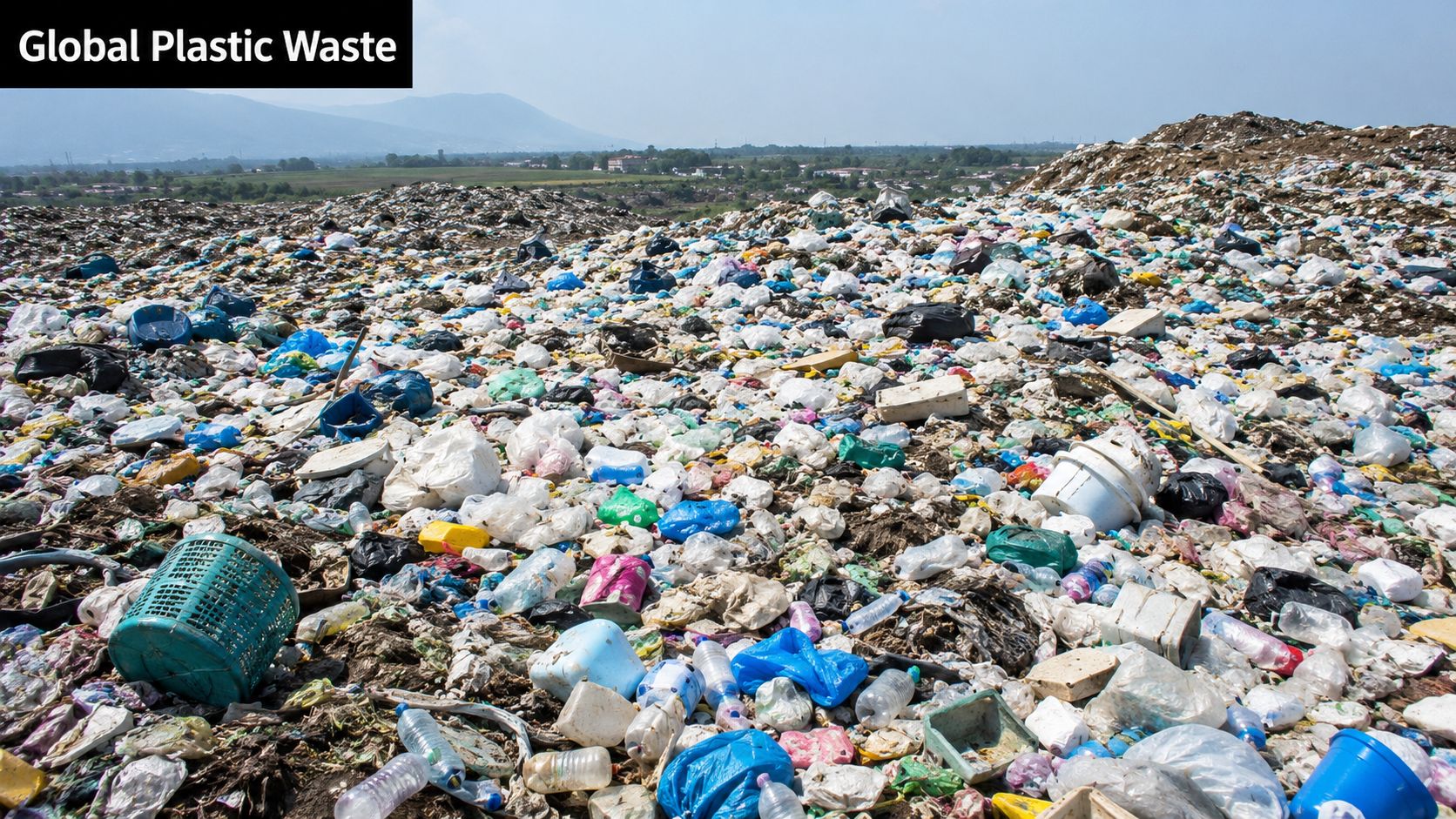
This isn't only a municipal waste problem. It's a stock problem. Every week's packaging flow adds to a backlog that remains in landfills, coastlines, rivers, and marine systems far beyond normal political cycles. Governments negotiate budgets annually and legislate in electoral terms. Plastic persistence operates on a century scale.
That mismatch matters for international governance. Countries may report progress on collection, bans, or recycling targets while still adding to an environmental inventory that remains active for decades or centuries. A useful policy lens is to treat plastic not only as waste, but as a dispersed, durable pollutant with transboundary consequences.
For policymakers tracking treaty design or circular economy reform, this analysis of solving the plastic problem is a useful companion because it places national action within a wider cooperation framework.
Why persistence alters policy design
Plastic's longevity changes what effective regulation looks like.
- Short-term disposal metrics mislead: A product can leave a household bin quickly and still remain in the environment for centuries.
- National systems can externalise harm: Export, landfill, and unmanaged leakage push long-run costs outside immediate reporting frameworks.
- Public communication often understates risk: Citizens hear “degrades” and assume disappearance, when persistence may instead change form.
Practical rule: If a material remains in the environment across multiple generations, policymakers should regulate it as a legacy pollutant, not as routine packaging waste.
That's why “how long does it take plastic to degrade” isn't a consumer curiosity. It's a core question for liability, product standards, and multilateral burden-sharing.
Degradation vs Biodegradation A Critical Policy Distinction
Why the words matter
The most common error in plastic policy is to treat degradation and biodegradation as if they were interchangeable. They aren't.
A simple analogy helps. If a block of ice shatters, it becomes smaller pieces of ice. If it melts, it changes state completely. Much plastic behaves more like the first process. It breaks into smaller fragments through physical or chemical stress, but it doesn't convert into harmless natural substances under ordinary conditions.
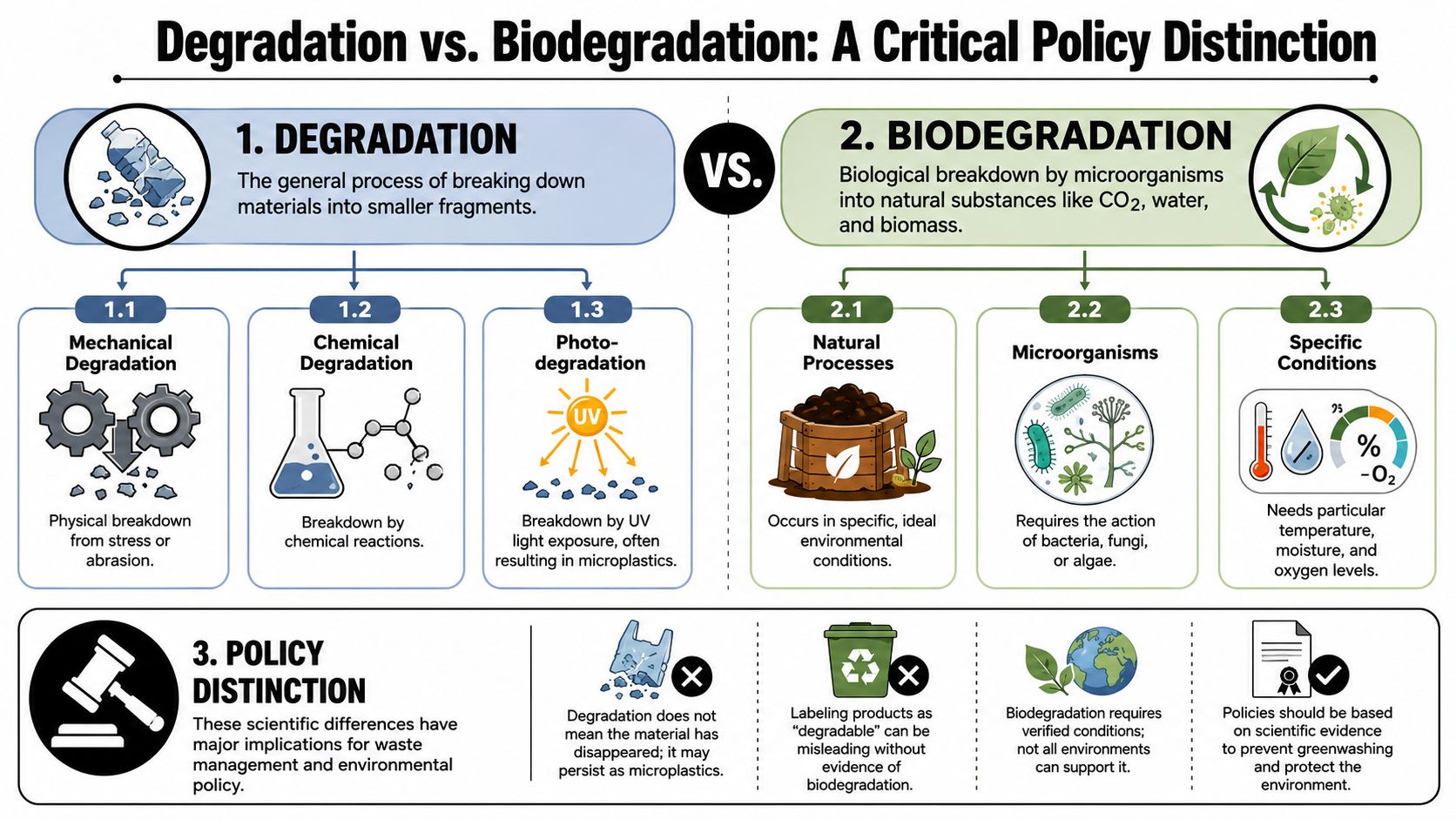
That distinction is directly relevant to UK and international rules. The UK's discrepancy between decomposition and biodegradation is critical for policymakers. Plastic bottles can take up to 450 years to fragment in UK landfills, but they do not biodegrade. Instead, they persist as microplastics with no verifiable end-point, as outlined in this UK waste guide on decomposition and biodegradation.
Photodegradation complicates public understanding further. Ultraviolet exposure can make plastic brittle and cause visible breakdown, but visible breakdown is not the same as molecular disappearance. Regulators who accept fragmentation as proof of environmental safety risk approving materials that instead create smaller, harder-to-track contaminants.
A practical explainer on terminology and disposal claims appears in Afida's Compostable vs Biodegradable guide. It's useful because product labels often collapse several different processes into one reassuring word.
Later in the policy conversation, a short visual can help non-specialist audiences grasp the difference:
A practical test for regulators
A credible rule should ask three questions.
Does the material fully biodegrade, or only fragment?
If the answer is fragmentation, the pollution pathway remains open.Under what conditions does breakdown occur?
Industrial composting, home composting, marine exposure, and landfill burial are not equivalent.Is there a verifiable end-point?
If regulators can't identify what the material becomes and under which conditions, claims of environmental benignity should be treated cautiously.
A material that becomes invisible isn't necessarily a material that has gone away.
Here, governance often fails. Labelling schemes reward optimistic terminology. Procurement rules sometimes follow marketing language. Consumers infer “biodegradable” means low risk in any setting. That chain of misunderstanding produces policy error at scale.
Plastic Degradation Timelines Across Key Environments
What different environments do to the same material
A single disposal pathway can lock in pollution for centuries. UNEP's assessment of marine litter reports benchmark persistence estimates of about 20 years for plastic bags, 200 years for drink cans, 400 years for plastic beverage bottles, and 600 years for fishing line in marine conditions, according to the UNEP report Marine Litter: A Global Challenge. Those figures are best read as governance signals, not precise expiry dates. They indicate long residence times in systems where recovery rates are low and ecological exposure is continuous.
The policy relevance lies in environmental divergence. The same product can behave differently in open water, coastal sediments, soil, and landfill because sunlight, oxygen, abrasion, temperature, and microbial activity differ sharply across those settings. For G7 and G20 regulators, that means a single headline number for “time to degrade” has limited value unless it is tied to a defined environment and a defined endpoint.
Landfill deserves separate treatment because it often receives products sold with reassuring end-of-life claims. The U.S. National Park Service notes that decomposition in landfill can be far slower than public messaging implies, listing disposable diapers at about 450 years and plastic beverage containers at about 450 years, with many plastics persisting because burial limits the conditions that drive surface breakdown, as set out in the National Park Service guide to decomposition rates. That matters for procurement and labelling rules. A product that degrades under controlled composting conditions may still persist for decades or centuries in the disposal route it enters.
Marine systems present a different governance problem. Lost or discarded fishing gear remains mobile, continues to entangle wildlife, and can keep catching fish while it slowly fragments. NOAA describes derelict fishing gear as a long-lived source of marine harm and identifies synthetic nets, lines, and traps as persistent debris in U.S. waters, as explained in NOAA Marine Debris Program guidance on fishing gear. Persistence here is not only a waste issue. It is also a fisheries management and maritime enforcement issue.
Reference table for common items
| Plastic Item | Marine Environment | Landfill Environment |
|---|---|---|
| Plastic bottle | About 400 years in UNEP marine litter guidance, referring to persistence in marine conditions and physical breakdown over extended periods, not verified full biodegradation, from UNEP | About 450 years in U.S. public waste education guidance from the National Park Service |
| Disposable nappy | No consistent verified estimate identified across major institutional marine sources | About 450 years in the National Park Service |
| Fishing line | About 600 years in UNEP marine litter guidance | No widely cited institutional landfill estimate identified |
| Fishing nets | Long-lived and persistent, with continuing ecological harm documented by NOAA Marine Debris Program | No widely cited institutional landfill estimate identified |
| Plastic carrier bag | About 20 years in marine conditions in UNEP marine litter guidance | No single authoritative global estimate. Persistence depends heavily on burial depth, oxygen, and material formulation |
Three conclusions matter for policy design.
First, persistence tables are useful only if they distinguish fragmentation from mineralization. A bottle that breaks into smaller particles after centuries has not reached a benign endpoint.
Second, leakage-sensitive products deserve environment-specific controls. Fishing gear, flexible packaging, and single-use containers do not create the same exposure pathways, so identical regulatory treatment is inefficient.
Third, G7 and G20 reporting standards should require each degradation claim to specify the receiving environment, test conditions, and end-state measured. Without that, timeline claims remain too ambiguous for credible governance.
Scientific Uncertainty and Measurement Challenges
Why estimates vary so widely
Plastic degradation numbers often look precise, but they're usually built from estimates, field observations, and extrapolations rather than a single universal clock. That's not a weakness in the science. It reflects the fact that plastics degrade under highly variable conditions.
Sunlight, oxygen, temperature, moisture, microbial activity, and abrasion all matter. So does shape. A thin bottle wall and a thick pipe made from related polymers won't behave the same way because their surface-area-to-volume ratios differ, and the environment can only attack exposed surfaces.
A strong example comes from high-density polyethylene. In UK marine environments, HDPE shows a specific surface degradation rate up to 11 μm per year, leading to estimated half-lives of 58 years for bottles but up to 1,200 years for thicker pipes, according to peer-reviewed research in ACS Sustainable Chemistry & Engineering. That's an important governance insight. Material category alone doesn't tell regulators enough. Geometry and exposure determine persistence.
What uncertainty means for global rules
Uncertainty shouldn't delay action. It should shape the type of action taken.
A precautionary framework is more defensible than a permissive one when scientific measurement is difficult and the environmental residence time is long. For G7 and G20 regulators, that means standards should avoid binary labels that imply certainty where none exists.
A better rule-set would include:
- Environment-specific testing: A product that passes industrial composting tests shouldn't automatically qualify for broad biodegradability claims.
- Endpoint-based definitions: Rules should distinguish between fragmentation, partial deterioration, and complete biological mineralisation.
- Common reporting protocols: International negotiations need comparable testing methods so that one country's “biodegradable” product doesn't become another country's microplastic problem.
Scientific uncertainty is a reason to tighten standards, not relax them.
The measurement challenge also affects diplomacy. If countries use different test conditions, labels, and legal definitions, trade discussions on plastics become vulnerable to greenwashing disputes. Harmonisation isn't only an environmental goal. It's also a governance stability goal.
The Failure of Biodegradable Plastics in Real-World Conditions
Laboratory success is not field performance
“Biodegradable” plastics are often presented as an exit route from the persistence problem. The evidence doesn't support that assumption in ordinary environments.
In UK soil and marine environments, oxo-biodegradable plastic bags remain fully functional after three years, while PLA biodegrades completely in 28 days under controlled composting conditions but reaches only 13% degradation in 60 days in natural settings, according to the UK review of standards for biodegradable plastics.
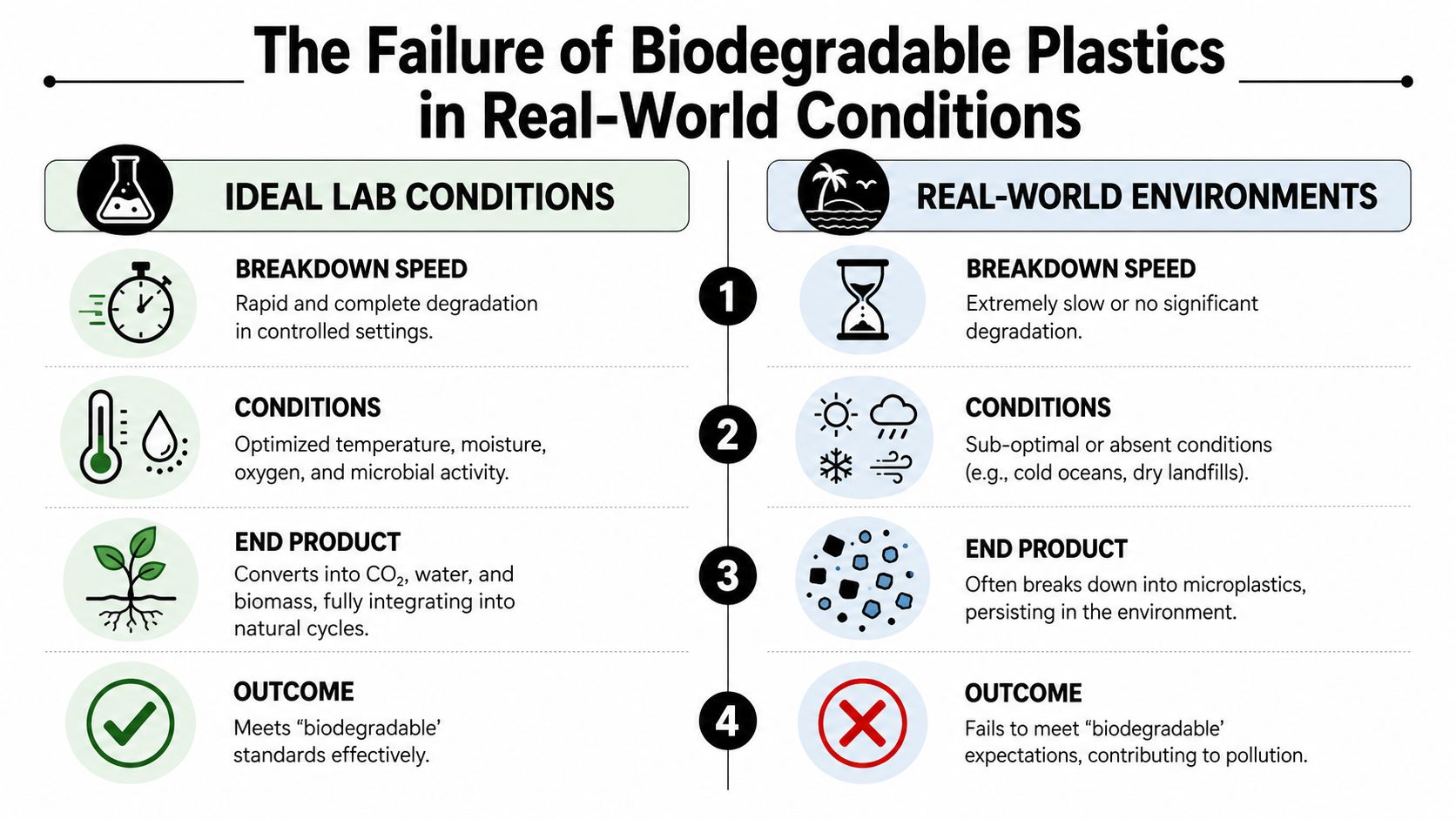
That gap between controlled conditions and real disposal settings is the policy issue. Industrial composting can maintain temperature, moisture, oxygen, and microbial conditions. Beaches, rivers, roadsides, home compost heaps, and landfills can't. A material designed for one tightly managed system may fail almost entirely in the environments where mis-sorting and leakage occur.
For policymakers interested in circular economy design rather than simple substitution, this piece on the EU's circular economy potential is useful context because infrastructure and standards matter as much as materials.
The policy consequence of weak claims
The problem isn't that some alternative materials never work. It's that public claims often outrun real-world performance.
Three governance risks stand out:
- Misleading labelling: Consumers often treat “biodegradable” as a licence for casual disposal.
- Procurement error: Public buyers can select products that perform well in certification tests but poorly in actual waste streams.
- Infrastructure mismatch: Municipal systems may lack the industrial composting conditions needed for claimed benefits.
That's why regulators should approve environmental claims only when the product's expected disposal route matches the tested conditions. If the conditions can't be delivered at scale, the claim shouldn't be marketed as a broad environmental solution.
A Policy Roadmap for Multilateral Action
Build standards around real disposal conditions
G7 and G20 governments should start with a simple rule. Environmental claims must reflect the conditions a product is likely to encounter after use. That means harmonised international standards for biodegradability testing and labelling, with separate categories for industrial composting, home composting, marine exposure, soil exposure, and landfill conditions.
Standards also need to define success more carefully. Fragmentation should never be accepted as equivalent to biodegradation. If test protocols don't require a clear molecular endpoint, they leave room for products that merely convert visible litter into microplastic pollution.
Digital product traceability can support this shift. Tools such as DPP Grid's ESPR solution show how product-level information can help regulators and supply chains communicate composition, compliance status, and end-of-life instructions more clearly across markets.
Shift accountability upstream
Producer responsibility is the second pillar. If manufacturers remain insulated from end-of-life costs, they'll keep placing difficult-to-manage materials on the market. Extended Producer Responsibility frameworks can change those incentives by linking fees and obligations to product design, persistence, and recovery performance.
Governments should also use trade and procurement policy to reward designs that fit actual collection and treatment systems. The case for that approach strengthens when products carry durable identifiers and standardised environmental data. Public agencies working on treaty implementation and domestic reform can draw useful lessons from broader efforts on advocacy ending plastic waste.
A workable multilateral agenda has three parts:
- Standardise definitions internationally. “Biodegradable” should mean the same thing across jurisdictions, and only within named conditions.
- Price persistence into product design. EPR schemes should reflect long-term environmental burden, not just immediate waste handling.
- Back innovation that survives contact with reality. Governments should support materials and business models that perform in ordinary systems, not only in controlled demonstrations.
The central policy lesson is straightforward. Plastic persistence is not merely a waste-management issue. It is a governance issue shaped by scientific uncertainty, weak terminology, and long-lived environmental liabilities. Multilateral institutions should respond accordingly.
Global governance on plastics needs sharper standards, stronger accountability, and better public communication. Global Governance Media tracks the policy choices shaping that agenda across the G7, G20, climate, trade, and sustainability forums. Follow its analysis to turn scientific evidence into practical international action.