

Byline: Eleanor Hart, Senior Policy Analyst
Why does a concept that sits at the centre of democratic legitimacy still get treated as if it were only a glossary term?
That gap matters more than it appears. When officials ask how to define civil society, they're often trying to solve a practical problem: who should be consulted, who can implement, who carries social legitimacy, and who can warn government when formal institutions are missing what citizens need. In G7 and G20 settings, that question affects policy design far beyond domestic democratic theory. It shapes how governments approach public health delivery, climate transition, labour adjustment, anti-corruption, and trust in multilateral processes.
A weak definition produces weak engagement. If civil society is reduced to a narrow list of charities or treated as a ceremonial add-on to summit diplomacy, governments miss the intermediary institutions that translate citizen concerns into policy signals. They also lose channels for implementation in places where state reach is uneven and markets don't solve collective problems on their own. The core issue isn't semantic precision for its own sake. It is governance capacity.
For a G20 delegation, the strategic value of civil society lies in function as much as form. Civil society can widen consultation, improve policy uptake, surface distributional risks earlier, and strengthen accountability without folding every civic actor into the state. That independence is the point. Once policymakers grasp that, the request to define civil society stops being introductory and becomes operational.
Table of Contents
- Why Defining Civil Society Matters for Policy
- The Core Concept and Its Historical Roots
- A Typology of Civil Society Actors
- Key Functions of Civil Society in Modern Governance
- Measuring Civil Society Strength and Resilience
- Case Studies in G7 and G20 Engagement
- A Policymakers Framework for Effective Engagement
Why Defining Civil Society Matters for Policy
The policy mistake is usually the same. Governments treat civil society as a communications constituency when they should treat it as part of the operating environment of governance.
That distinction affects outcomes. In complex policy domains, officials rarely face a simple state-versus-market choice. They confront fragmented demand, uneven trust, and groups whose needs won't appear clearly in administrative data. Civil society helps close that gap because it often sits closer to communities, grievances, and implementation obstacles than central government does.
For G7 and G20 members, this matters in at least three ways:
- Legitimacy under pressure: Large-scale reforms in energy, welfare, migration, or health need visible channels for participation if they are to retain public consent.
- Delivery under constraint: Ministries often rely on non-state partners to reach populations that formal systems don't reach consistently.
- Accountability across borders: Summit commitments gain credibility when independent actors can monitor, contest, and interpret them in public.
Practical rule: If a government can only describe civil society as “stakeholders”, it probably hasn't mapped the institutions that shape trust, uptake, and policy resistance.
The strategic implication is that definition determines instrument choice. If leaders define civil society narrowly, they will over-consult large professionalised organisations and under-engage local associations, unions, faith bodies, volunteer networks, and informal civic action. If they define it too loosely, they risk collapsing important distinctions between public authority, commercial interest, and independent association.
In the G20 context, this isn't a side issue. It determines who enters consultation channels, who gets funding access, whose evidence is treated as legitimate, and whose absence later shows up as implementation failure. A climate plan, for example, may look technically coherent at summit level and still fail domestically if labour organisations, community groups, and local advocacy networks weren't part of the design process.
That is why the best policy question isn't “what is civil society?” It is “what governance functions are lost when civil society is misunderstood?” Officials who start there usually make better choices about consultation, regulation, and partnership. For a wider discussion of civic actors in practice, see how civil society organisations are making a difference.
The operational test
A useful definition must do more than classify organisations. It must help policymakers decide who is independent, who represents lived realities, and who can contribute to problem-solving without becoming an arm of the state or the market.
That is the threshold that matters in global governance. Civil society is strategically relevant because it expands the state's field of vision while remaining outside the state.
The Core Concept and Its Historical Roots
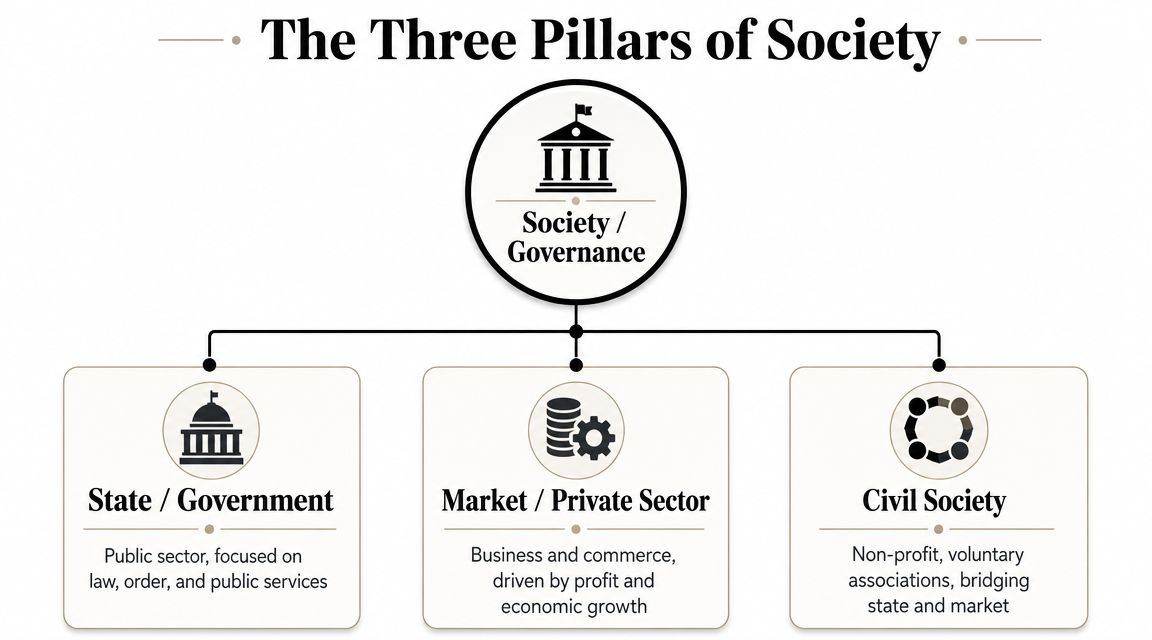
In policy terms, the most workable starting point is the three-sector model. It separates the state, the market, and civil society so that each can be understood by its core logic rather than by a list of organisations.
In the UK, civil society is commonly understood as the space between the state, the market and the household, including voluntary associations, charities, community groups, trade unions, faith groups and other non-governmental bodies formed by citizens to advance shared interests or the public good. UK policy practice reflects this distinction because charities are legally and administratively separate from government and business, and they must operate for public benefit. UK public policy literature also commonly describes civil society as the third sector, emphasising independence, participation, advocacy and accountability, as outlined in the ICNL analysis of defining characteristics of civil society.
A functional way to define civil society
Think of civil society as society's connective tissue. Governments legislate and administer. Markets allocate capital and produce goods and services. Civil society links people to collective action that isn't primarily coercive and isn't primarily profit-seeking.
That connective role helps explain why the term is often contested. Civil society includes formal institutions with boards, staff, and regulatory status. It also includes looser forms of association built around identity, belief, locality, profession, or cause. The category is broad because social cooperation itself is broad.
A concise policy definition would include three tests:
- Independence from government control
- Orientation to shared interests or public benefit rather than profit distribution
- Voluntary association by citizens or communities
Why the history still matters
The historical roots of the idea still shape its modern use. The term acquired force because observers of democratic life recognised that institutions between the citizen and the state matter. They generate habits of association, representation, bargaining, and scrutiny that formal constitutions alone can't provide.
Later, the concept became even more influential in debates on democratic transition and post-conflict reconstruction. Policymakers and donors increasingly treated civil society as a marker of democratic depth, not merely an accessory to elections. That shift made practical sense. Where citizens can organise independently, they can express interests, challenge abuse, build solidarity, and create non-state channels of problem-solving.
Civil society matters because it is one of the few arenas where participation, accountability, and social trust can be built at the same time.
For G7 and G20 officials, the historical lesson is straightforward. Civil society should not be approached as a decorative layer of consultation attached to an otherwise closed system. It is one of the institutional conditions that allows governments to detect emerging pressures before they become crises. It also creates a buffer against over-centralisation. In strategic terms, that makes civil society part of democratic resilience.
A Typology of Civil Society Actors
The phrase civil society becomes misleading when it is used as though it describes a single bloc. It doesn't. Policymakers need a working typology because the methods that fit a national charity won't fit a trade union, and the engagement model that works for a faith-based network won't fit a digital campaign coalition.
UK-focused sources are especially useful here because they stress that civil society is not a fixed list. It is a broad and contested ecosystem. Charities are only one part of that wider sphere, which also includes mutuals, faith groups, campaign networks, trade associations, volunteer groups, and informal community action, as noted in the UN terminology reference discussing the breadth of civil society.
Why the category is broader than most officials assume
Many ministries default to the organisations that are easiest to identify. Registered charities, large NGOs, and established foundations usually have formal contact points, policy staff, and consultation experience. That makes them visible, but visibility isn't the same as representativeness.
Less formal actors often carry different forms of authority:
- Community-based groups understand local service gaps and implementation barriers.
- Trade unions and professional associations bring organised sectoral knowledge.
- Faith-based bodies can mobilise trust and voluntary action at community level.
- Campaign networks and social movements surface issues that formal institutions may prefer to defer.
- Mutuals and volunteer groups often show where citizens are organising outside conventional advocacy channels.
A narrow map of the civic realm usually leads to a narrow theory of public consent.
Typology of actors and policy relevance
The table below is not exhaustive, but it gives officials a practical frame for identifying who does what in G7 and G20 processes.
| Actor Type | Primary Function | Example | G7/G20 Relevance |
|---|---|---|---|
| Charities and NGOs | Service delivery, advocacy, research, public education | A public health charity or humanitarian NGO | Useful for implementation insight, social impact evidence, and policy feedback |
| Community-based organisations | Local problem-solving and representation | Neighbourhood associations, local volunteer groups | Critical for place-based delivery and identifying unmet needs |
| Faith-based organisations | Social support, mobilisation, values-based advocacy | Church, mosque, temple, or interfaith service networks | Important in trust-building, humanitarian response, and social cohesion |
| Trade unions | Labour representation and collective bargaining | National union federations or sector unions | Central to just transition, labour standards, and industrial policy dialogue |
| Professional associations | Standards, expertise, and sector advocacy | Medical, legal, or teaching associations | Valuable for technical policy design and implementation realism |
| Campaign networks and social movements | Agenda-setting and public pressure | Climate campaign coalitions or anti-corruption movements | They shift political salience and can force under-addressed issues onto summit agendas |
| Mutuals and membership bodies | Collective provision and member representation | Cooperatives or member-run associations | Relevant to inclusive growth, financial resilience, and social economy debates |
| Digital activist networks | Rapid mobilisation and public narrative formation | Online issue-based coalitions | Important for issue amplification, scrutiny, and reputational pressure |
This is also why engagement architecture matters. The formal C20 track captures one part of the ecosystem, but not all of it. Officials who want a clearer view of how that process works can review the workings of the C20.
A practical mapping exercise should classify civic actors by independence, constituency, operating scale, and route to influence. Legal form alone won't tell you enough.
For a G20 delegation, the point of typology isn't administrative neatness. It is risk management and policy quality. Different actors reveal different failure points. Community groups identify where delivery stalls. Unions flag distributional consequences. Advocacy networks identify legitimacy risks. Professional bodies test operational feasibility. Together, they provide a more accurate picture of governance than any single consultation channel can.
Key Functions of Civil Society in Modern Governance
Civil society earns strategic significance not because it exists, but because it performs functions that states and markets often cannot perform alone.
A central insight from UK evidence is that civil society organisations act as intermediaries that reduce information asymmetry between citizens and the state. They identify unmet needs, aggregate demand, and channel it into consultation, advocacy and service delivery. Stronger intermediary capacity is associated with greater accountability and stronger uptake of public programmes, while weak civic infrastructure is associated with lower trust and less effective delivery in complex policy domains, as discussed in the analysis of civil society and intermediary capacity.
Intermediation is the strategic function
That intermediary role is often underestimated in summit diplomacy. Governments usually focus on the visible outputs of civil society, such as campaigns, policy briefs, protests, or service contracts. The deeper value lies in translation. Civil society converts diffuse social experience into forms that public institutions can process.
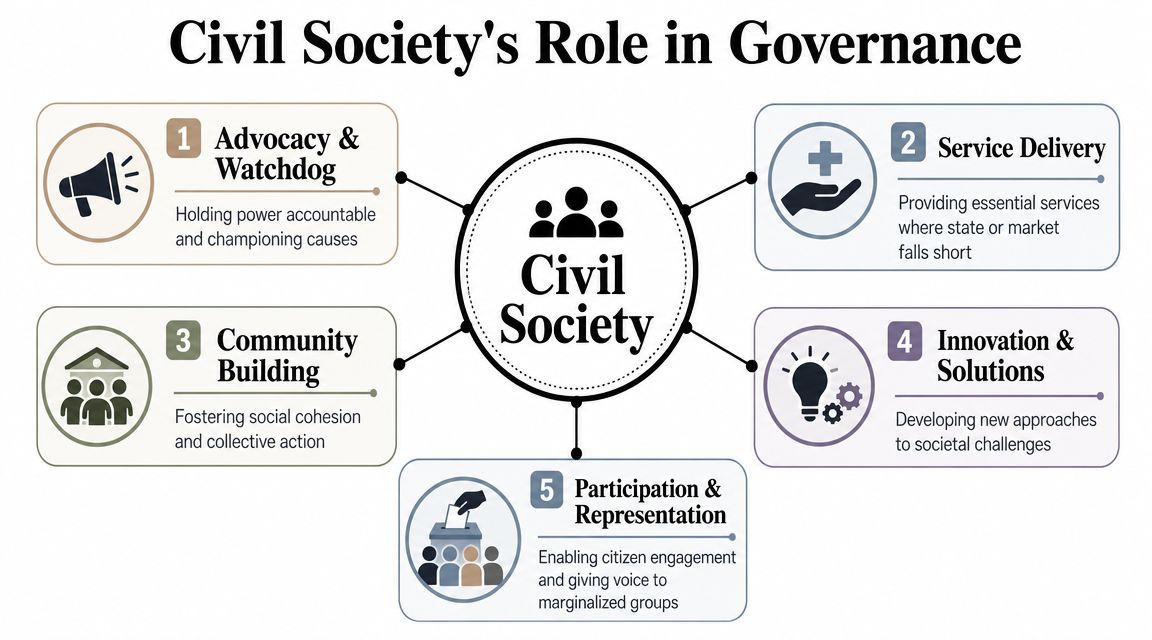
When that translation layer is thin, governments face a distorted policy environment. They hear louder actors, not necessarily more affected ones. They measure programme rollout, not real uptake. They see compliance, not trust.
Four governance roles that matter most
A useful policy framework is to treat civil society in four roles.
Watchdog
Civil society scrutinises power, contests official narratives, and keeps policy failures in public view. This function is often uncomfortable for governments, but it is indispensable. Without organised scrutiny, accountability narrows to elections and administrative review.
Service provider
Many civic actors deliver support where state systems are stretched or where market incentives are weak. In practice, this can include welfare support, humanitarian assistance, advice services, and community health work. Their value isn't only the service itself. It is the intelligence generated through delivery.
Before the next point, it helps to see how the broader role is usually framed in public explanation:
Community builder
Civic associations create habits of cooperation, trust, and reciprocity. In governance terms, that strengthens social cohesion and makes collective adjustment more feasible during crises or reform periods.
Policy partner
Some organisations engage directly in consultation, evidence gathering, and programme co-design. The strongest partnerships don't ask civil society to validate pre-written policy. They ask it to identify blind spots before those become political or administrative failures.
Governance test: If civic actors can speak only after implementation begins, they are not functioning as policy partners. They are being used as post hoc validators.
For G7 and G20 leaders, these functions should inform process design. A serious engagement model creates room for challenge as well as endorsement. It also recognises that service delivery and advocacy often sit in the same organisation. Treating those roles as mutually exclusive is one of the most common government errors.
Measuring Civil Society Strength and Resilience
Officials often ask whether civil society is “strong” or “weak” as if the answer were self-evident. It isn't. Strength has to be measured through a combination of institutional, financial, legal, and participatory indicators.
The first mistake is to rely on headline visibility. A country may have prominent NGOs and frequent public campaigns while still lacking a resilient civic ecosystem. The second mistake is to rely on registration counts alone. Formal presence doesn't reveal independence, reach, or capacity to influence decisions.
What to measure instead of relying on rhetoric
A workable measurement framework should focus on operational indicators such as:
- Organisational independence: Can groups act without capture by party or commercial interests?
- Breadth of participation: Are people able to join, volunteer, organise, and contribute through multiple channels?
- Geographic reach: Does civil society extend beyond capital cities and well-funded institutions?
- Influence on decision-making: Are civic actors heard early enough to affect policy design?
- Financial resilience: Do organisations have stable enough support to operate beyond short cycles?
- Regulatory environment: Does the legal setting allow association, advocacy, and public benefit activity without arbitrary constraint?
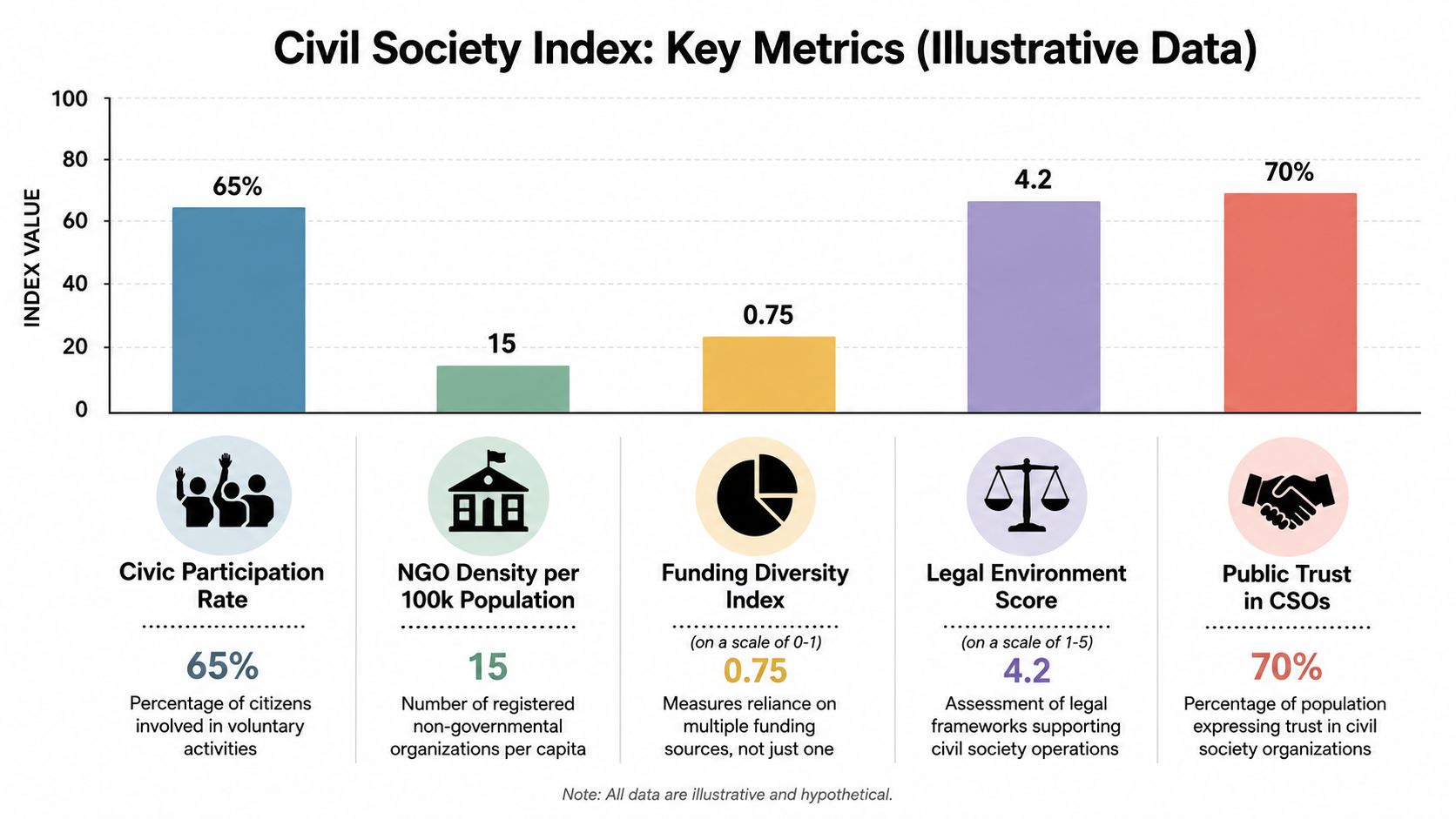
These indicators matter because they reveal different kinds of resilience. A financially stressed sector may still have broad legitimacy. A legally protected sector may still be geographically thin. A large formal sector may still exclude informal community action.
What UK scale data does and does not tell us
The UK offers a useful example of why scale should be treated carefully. The UK Civil Society Almanac reports a sector with a total income of about £89 billion and around 163,000 voluntary organisations, as cited in the U4 overview referencing the UK Civil Society Almanac. Those figures confirm that civil society is economically and institutionally significant.
But scale is not the same as resilience. The same evidence warns that headline figures can obscure fragility because many organisations rely on short-term grants and smaller community groups are often underrepresented. For policymakers, that has a direct implication. Apparent capacity at national level can coexist with weak local infrastructure.
The right question isn't whether civil society is large. It is whether it can remain independent, representative, and operational when pressure rises.
For G7 and G20 governments, measurement should therefore move beyond ceremonial engagement counts or the number of invited organisations. What matters is whether civic infrastructure is durable enough to inform policy, challenge policy, and help carry policy into practice.
Case Studies in G7 and G20 Engagement
In summit politics, civil society influence rarely appears in a straight line. It works through agenda pressure, public framing, technical contribution, and implementation partnerships that continue after leaders leave the room.
Three patterns matter most for policymakers.
Policy influence through organised advocacy
The first pattern is policy influence through organised advocacy platforms. In G7 and G20 environments, coalitions of NGOs, think tanks, labour groups, and development advocates often package demands into summit-facing recommendations. Their influence usually comes less from formal voting power than from persistence, coalition breadth, and the ability to connect summit language to domestic political pressure.
When this works well, governments gain a structured outside view of blind spots in draft priorities. Civil society groups often identify where official communiqués are over-general, where implementation language is missing, or where social consequences have been underplayed. This is particularly relevant in global health and inclusive growth debates, where the political cost of weak follow-through can be high.
A practical illustration of this dynamic can be seen in the Civil 20 contribution to the Osaka Summit, which shows how organised civic engagement seeks to shape agenda formation rather than merely react to final communiqués.
Productive tension in contested agendas
The second pattern is productive tension, especially in climate policy. Governments often prefer consensus-friendly language and staged ambition. Civil society actors, especially campaign networks and youth-led movements, often press for sharper timelines, stronger accountability, and greater distributional fairness.
That tension is not a governance failure. In many cases, it is the mechanism that keeps politically difficult issues visible. Activist pressure can widen the feasible policy conversation by making incrementalism harder to defend publicly. Officials may regard this as disruptive, but strategically it can be useful. It surfaces the distance between declared ambition and operational policy before credibility erodes further.
This is one reason governments should resist engaging only with the most institutionally comfortable actors. A system that excludes disruptive but non-violent civic pressure loses an early warning function.
Implementation partnerships beyond the summit room
The third pattern is co-production in implementation. Summit commitments often depend on domestic delivery through national and local institutions. That is where civil society frequently becomes indispensable.
Consider the general logic of social programme delivery. Governments may establish eligibility rules, financing frameworks, and administrative standards. Civil society organisations often identify hard-to-reach populations, explain programme access, feed back evidence on barriers, and maintain trust where public institutions face scepticism. In this role, they are not replacing the state. They are improving state reach and responsiveness while remaining distinct from it.
That distinction matters for legitimacy. Civil society can support implementation precisely because it is not the same thing as government. If officials treat civic actors merely as low-cost contractors, they strip away the independence that gives those actors their social value.
A mature G20 approach therefore requires two capacities at once. It needs structured pathways for influence in agenda-setting, and it needs operational partnerships in delivery. Too many governments build one and neglect the other.
A Policymakers Framework for Effective Engagement
Governments don't need a more elaborate rhetorical commitment to civil society. They need a better engagement model.
The strategic principle is simple. Civil society should be treated neither as an oppositional nuisance nor as a ceremonial partner. It is an independent governance asset. Its value comes from the fact that it can represent, contest, convene, and implement without being reducible to state authority or commercial interest.
Four principles for serious engagement
First, build formal channels without forcing uniformity.
Structured engagement mechanisms are necessary, especially around G7 and G20 processes, but they shouldn't assume that all civic actors engage in the same way. Large NGOs, unions, faith networks, local groups, and informal coalitions require different interfaces.
Second, protect independence as a design principle.
Consultation is hollow if participants fear regulatory retaliation, political capture, or financial dependency that strips away autonomy. Governments should want civic actors that can disagree credibly.
Third, diversify who gets heard.
If consultation relies only on large, capital-based organisations, governments receive a polished but incomplete picture. Broader engagement improves representativeness and helps avoid policy designed by proximity rather than need.
Fourth, evaluate engagement by influence, not attendance.
The number of meetings held tells ministers very little. The better test is whether civic input changed timing, sequencing, targeting, or implementation design.
Decision rule: Engage civil society early enough to affect policy choices, and broadly enough to expose social risk before it becomes political risk.
What G7 and G20 officials should do differently
A delegation preparing for a summit should ask four hard questions.
- Who is missing from the room? The answer usually reveals where implementation trouble will emerge.
- Which actors can challenge our assumptions? Agreement is less useful than informed friction.
- Where are we treating delivery partners as substitutes for civic voice? Service contracts do not replace representation.
- Can this ecosystem endure pressure? If not, today's consultation may produce tomorrow's compliance gap.
To define civil society well is to govern more realistically. It means recognising that legitimacy, accountability, and delivery depend on institutions that sit outside both government and the market. For G7 and G20 leaders facing fragmented trust and complex transnational risks, that isn't an abstract democratic virtue. It is part of the machinery of effective rule.
For deeper analysis on summit diplomacy, multilateral policy, and the practical role of civic actors in global decision-making, follow Global Governance Media. Its coverage helps policymakers, analysts, and institutional leaders turn complex G7 and G20 debates into clearer strategic choices.