

By Elias Maren, Senior Policy Analyst
The ocean covers about 70% of Earth's surface, a basic physical fact that should shape how governments define economic resilience, climate risk, and international security. Framing the question of why are oceans important through this systems lens leads to a different conclusion than standard environmental messaging. The ocean is not a sectoral concern. It is shared planetary infrastructure that regulates climate, supports trade routes, underpins food and energy systems, and influences the stability of coastal economies.
For G7 and G20 governments, the strategic implication is clear. Ocean policy belongs alongside fiscal planning, supply chain security, energy transition policy, and risk management. Treating it as a narrow conservation file creates policy fragmentation across ministries that oversee shipping, fisheries, ports, critical minerals, disaster resilience, and climate adaptation.
That fragmentation is costly.
Ecological stress in the ocean transmits into economic losses, social vulnerability, and sharper interstate competition over access, standards, and enforcement. A coherent policy framework therefore has to connect three dimensions at once: the ocean as a life-support system, the ocean as an engine of prosperity, and the ocean as a contested domain of governance. That integrated view is the one multilateral forums now need.
Table of Contents
- Why the Ocean Is a Core Multilateral Issue
- The Ocean as Earth's Primary Life Support System
- The Blue Economy and Global Prosperity
- Oceans Food Security and Human Wellbeing
- A New Arena for Geopolitical Competition
- The Fractured State of Global Ocean Governance
- An Actionable Policy Agenda for the G7 and G20
Why the Ocean Is a Core Multilateral Issue
Multilateral institutions often separate climate, trade, development, and security into different negotiating tracks. Ocean policy exposes the limits of that habit. A damaged ocean system doesn't stay inside one ministry's remit. It reaches finance ministries through trade exposure, agriculture ministries through food supply, defence ministries through maritime vulnerability, and climate ministries through heat and carbon dynamics.
The UK offers a useful policy lens because it is both a maritime economy and a climate-exposed state. According to the verified evidence provided, the UK Parliament's research on the blue economy notes that the country's marine economy contributes tens of billions of pounds to output and supports major coastal employment clusters. That matters beyond the UK because many G20 economies, whether coastal or trade-dependent, face the same structural dependence.
Why this matters to summit diplomacy
G20 communiqués frequently aim to balance growth, resilience, and decarbonisation. Ocean policy sits at the centre of that triangle.
- Growth depends on marine systems: Ports, shipping, offshore energy, fisheries, tourism, and coastal services all depend on functioning seas.
- Resilience depends on marine ecosystems: Coastal protection, storm buffering, and food-chain stability all weaken when ecosystems degrade.
- Decarbonisation depends on ocean integrity: The climate system doesn't operate separately from the sea.
Policy test: If an issue affects climate regulation, trade continuity, food security, and infrastructure risk at the same time, it belongs on the core multilateral agenda.
The hidden infrastructure argument
The ocean is often described as nature. For policymakers, it is more accurate to treat it as natural infrastructure. It shapes rainfall patterns, moderates temperature extremes, influences storm behaviour, and supports maritime commerce. Those functions are as strategically relevant as roads, grids, and ports, except they operate at planetary scale.
That insight leads to a harder conclusion. Ocean degradation is not only an environmental loss. It is a governance failure with spillovers across sovereign balance sheets, social stability, and regional security. G7 and G20 leaders can't meet their own objectives on adaptation, food resilience, and secure trade unless they treat the ocean as a shared operating system for the world economy.
The Ocean as Earth's Primary Life Support System
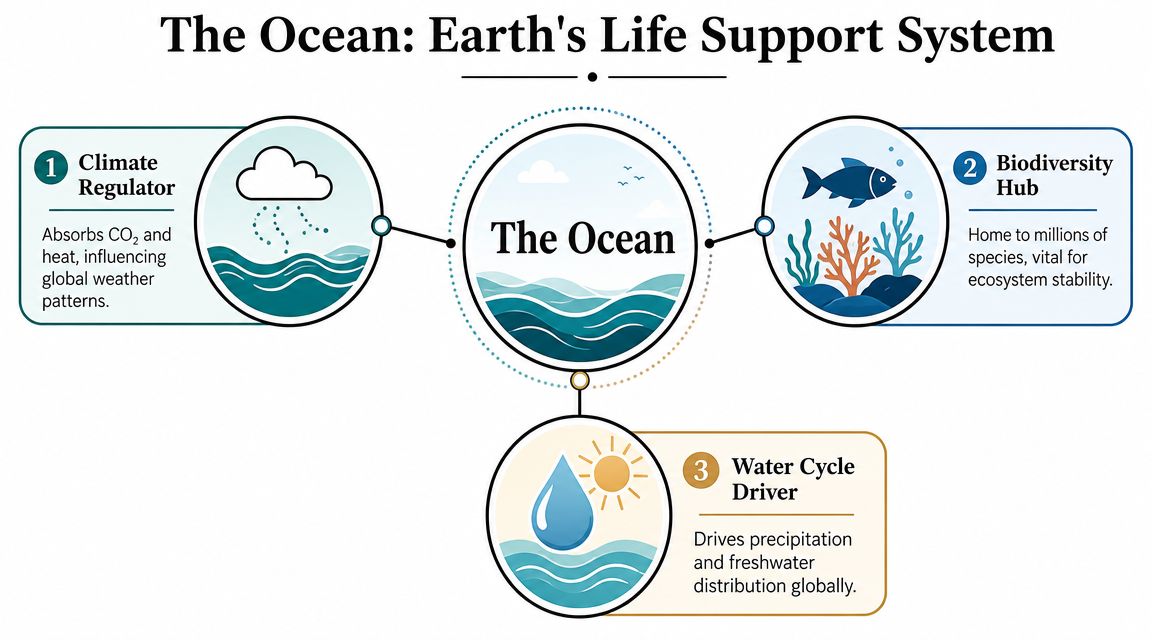
More than 90% of the excess heat added to the climate system has been taken up by the ocean since the 1970s, according to the IPCC Sixth Assessment Report. That figure shifts the policy frame. The ocean is not a passive recipient of climate change. It is a core part of the planetary system that makes economic activity, food production, and social stability possible.
Climate regulation
The ocean regulates temperature by absorbing heat, storing it, and redistributing it through currents and circulation. The IPCC assessment of the physical science basis shows that ocean warming is already altering marine heatwaves, stratification, and circulation patterns. Those changes affect far more than coastal environments. They shape storm intensity, rainfall distribution, and the reliability of the environmental conditions on which agriculture, infrastructure planning, and insurance models depend.
For finance ministries and central planners, the implication is direct. A more unstable ocean raises the probability of correlated shocks across sectors that are usually managed separately, including water systems, transport corridors, public health, and disaster response.
Carbon uptake, oxygen production, and biosphere stability
Marine ecosystems also perform biochemical functions that no state can replicate at scale. The UNESCO Ocean Literacy framework explains that the ocean generates much of the oxygen in the atmosphere through marine plants and plankton, while absorbing a large share of anthropogenic carbon dioxide emissions. The NOAA explanation of ocean acidification makes clear that this carbon uptake has a cost. As more carbon dioxide dissolves into seawater, ocean chemistry changes, placing stress on corals, shell-forming organisms, and wider marine food webs.
That creates a policy linkage that is often missed. Climate mitigation, biodiversity protection, and long-term development finance are connected through the same marine processes. Governments that separate these agendas in budget design or international negotiations will understate system risk.
A practical consequence follows. Aligning public and private investment with ocean health is not only an environmental preference. It is a way to protect climate regulation, biological productivity, and the stability of assets exposed to coastal and marine disruption.
The water cycle and weather stability
The ocean also drives the global water cycle. The World Meteorological Organization overview of the ocean-climate nexus describes how ocean-atmosphere interactions influence evaporation, precipitation, monsoons, and large-scale climate variability. In policy terms, this means ocean disruption can appear inland, through drought risk, flood exposure, reservoir stress, and lower crop predictability.
This is one reason ocean governance belongs in G7 and G20 discussions, even for countries that do not see themselves as maritime powers. Ocean instability travels through food prices, energy demand, disaster spending, migration pressures, and fiscal risk.
What this means for decision-makers
Three conclusions follow.
- Ocean policy is macroeconomic risk management. It reduces the likelihood that environmental disruption will become a fiscal or humanitarian crisis.
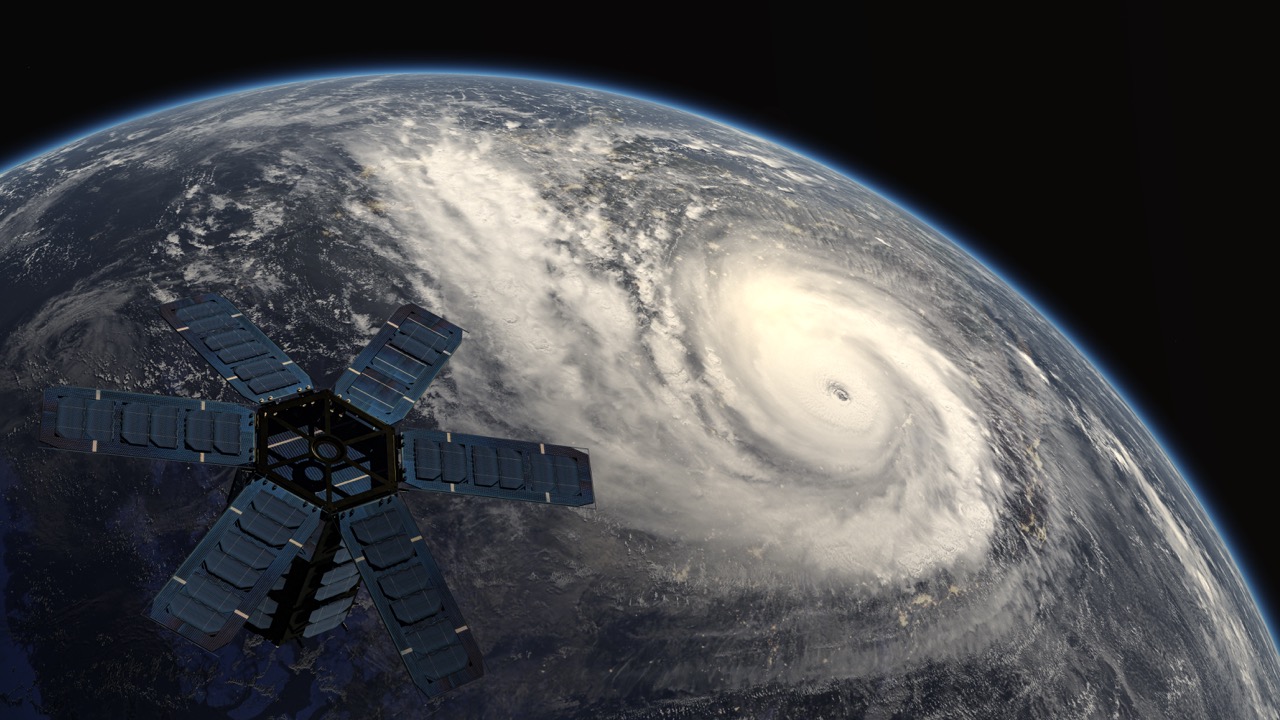
- Marine observation is strategic intelligence. Better monitoring improves decisions on adaptation, infrastructure, food systems, and disaster preparedness.
- Ocean protection is cross-sector policy. It supports climate goals, biodiversity outcomes, and economic resilience at the same time.
The central governance point is straightforward. The ocean's ecological functions, economic value, and security implications are part of the same policy problem. Treating them separately weakens both national strategy and multilateral coordination.
The Blue Economy and Global Prosperity
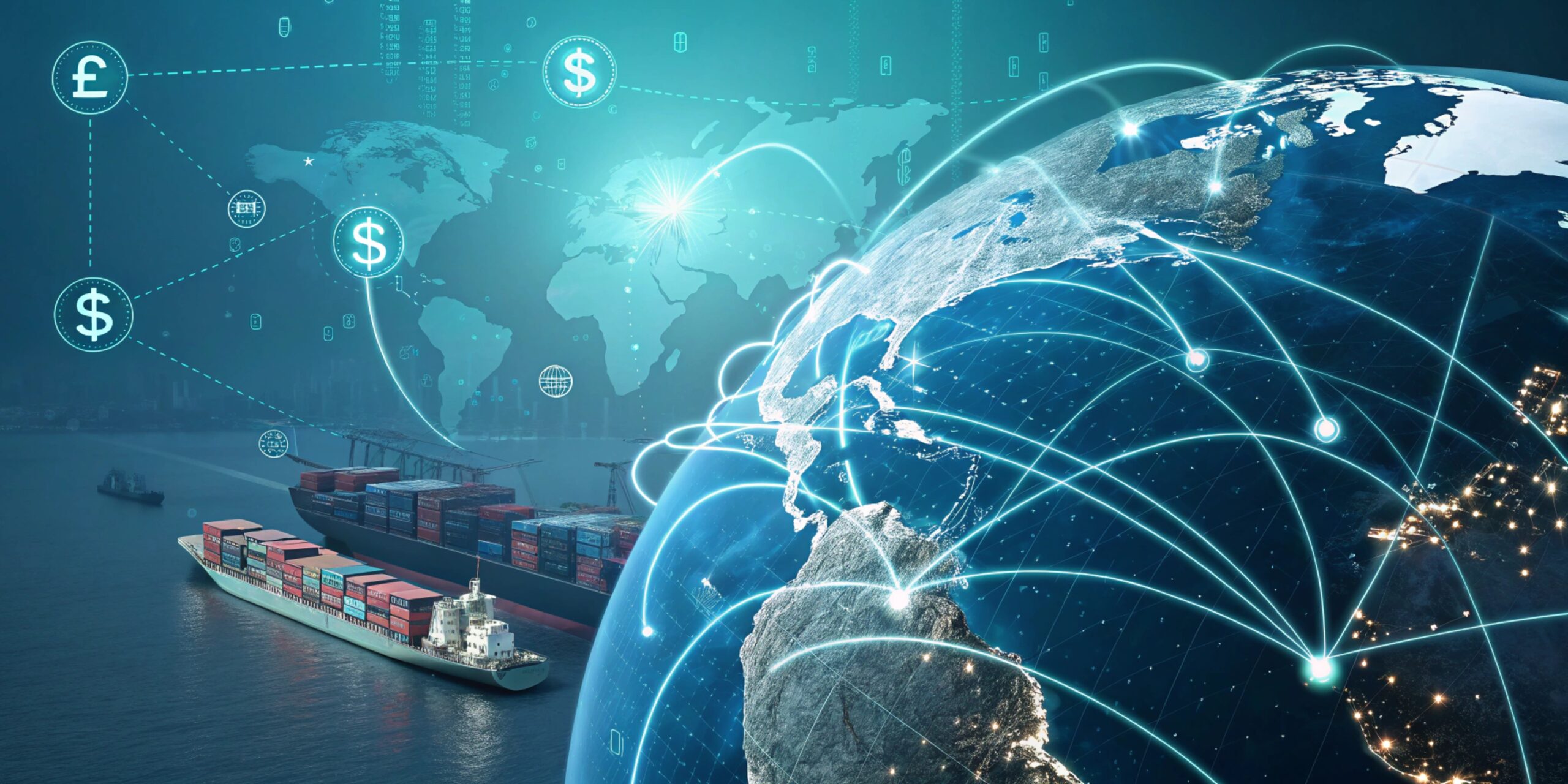
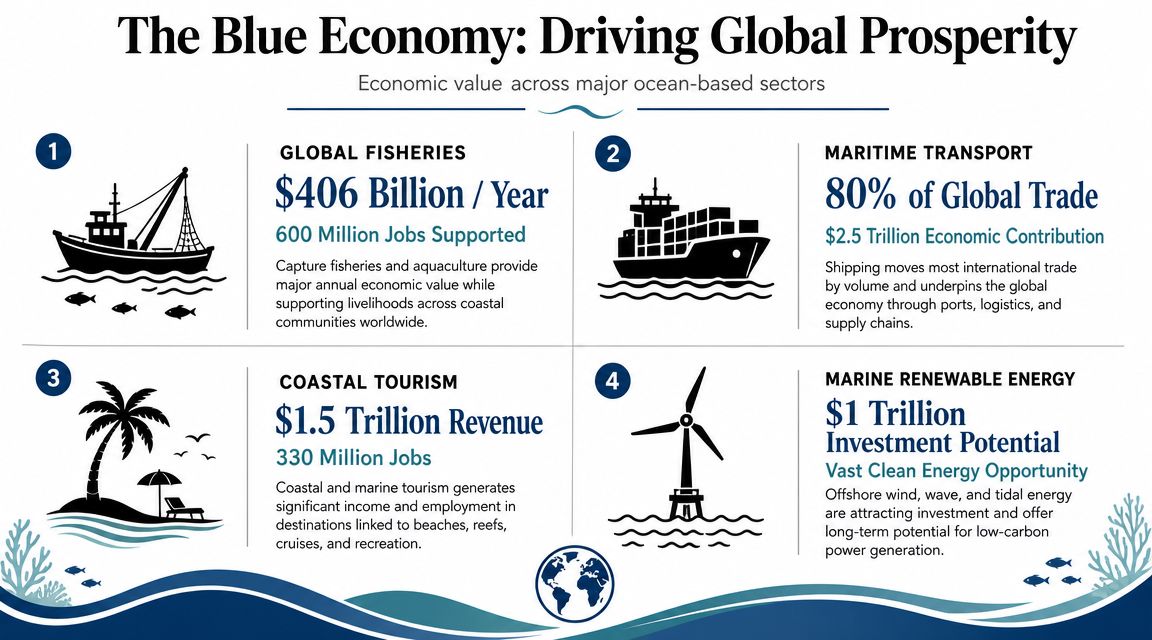
About 80% of global trade by volume is carried by sea, according to UNCTAD. That single figure explains why ocean policy belongs in economic strategy, not only environmental policy. For G7 and G20 governments, the ocean is a connected system that links trade logistics, energy security, coastal employment, infrastructure resilience, and the condition of marine ecosystems.
The term blue economy often gets narrowed to fisheries and tourism. That framing is too limited for policy use. Ocean-based activity also includes shipping, ports, offshore energy, subsea cables, shipbuilding, marine services, and the coastal industries that depend on them. The strategic point is straightforward. Economic output from the ocean depends on ecological stability, physical infrastructure, and rules that reduce conflict over increasingly crowded marine space.
Beyond fisheries and tourism
A more complete definition of ocean dependence changes how governments assess risk. Disruption at sea affects import costs, delivery times, energy supply, and industrial production inland. It also affects inflation and fiscal planning, especially in economies that rely heavily on imported fuel, food inputs, or manufactured components.
The UK offers a useful illustration. A UK Parliament research briefing on the blue economy describes a broad maritime economy spanning ports, shipping, offshore energy, marine manufacturing, and coastal services. The wider lesson for G20 members is not the UK case itself. It is that ocean-linked activity tends to be spread across multiple ministries while the risks remain concentrated in a few critical nodes, such as ports, estuaries, shipping lanes, and offshore energy zones.
Three implications follow.
- Maritime transport is a macroeconomic transmission channel: Port delays, route disruption, and higher shipping costs can feed through to inventories, producer prices, and consumer inflation.
- Marine space is now part of energy strategy: Offshore wind, transmission infrastructure, and competing maritime uses require governments to coordinate energy planning with marine regulation.
- Coastal concentration creates political exposure: Ocean-linked jobs and assets are often geographically clustered, so marine disruption can become a regional employment and fiscal problem quickly.
Why finance ministries should care
Finance ministries usually encounter ocean issues indirectly, through trade volatility, insurance losses, disaster recovery costs, and weaker performance in exposed coastal regions. That fragmented view understates the policy problem. The same marine areas often support commercial shipping, fisheries, energy projects, biodiversity goals, and security interests at the same time. Decisions in one domain can reduce value in another if governments assess them in isolation.
| Ocean-linked system | Why it matters strategically | Policy implication |
|---|---|---|
| Maritime trade | Carries most goods by volume and supports supply chain continuity | Protect route reliability, port efficiency, and coastal infrastructure |
| Offshore energy | Expands domestic generation and affects energy security | Coordinate marine spatial planning with energy and grid policy |
| Coastal employment | Concentrates jobs and tax bases in exposed regions | Link adaptation spending with labour market and regional policy |
This is why the blue economy should be treated as an asset-management question, not only a growth question. Ports, shipping corridors, fisheries, reefs, wetlands, and offshore energy sites are interdependent assets with shared exposure to climate risk, pollution, congestion, and weak regulation. A government can raise short-term output while degrading the marine systems that support long-term productivity.
That tension is already visible in investment decisions. Capital can support resilient ports, lower-impact shipping, better marine data, and coastal ecosystem protection, or it can reinforce patterns that increase future losses. The policy case for aligning investments with ocean health follows directly from that reality. Blue growth is economically durable only if ecological conditions, infrastructure planning, and governance rules are designed together.
Oceans Food Security and Human Wellbeing
For many communities, the ocean is not an abstract global system. It is dinner, income, transport, identity, and protection. That human reality is central to why are oceans important. It is also where global inequality becomes visible, because the costs of marine decline usually fall first on those with the least fiscal space and the fewest alternatives.
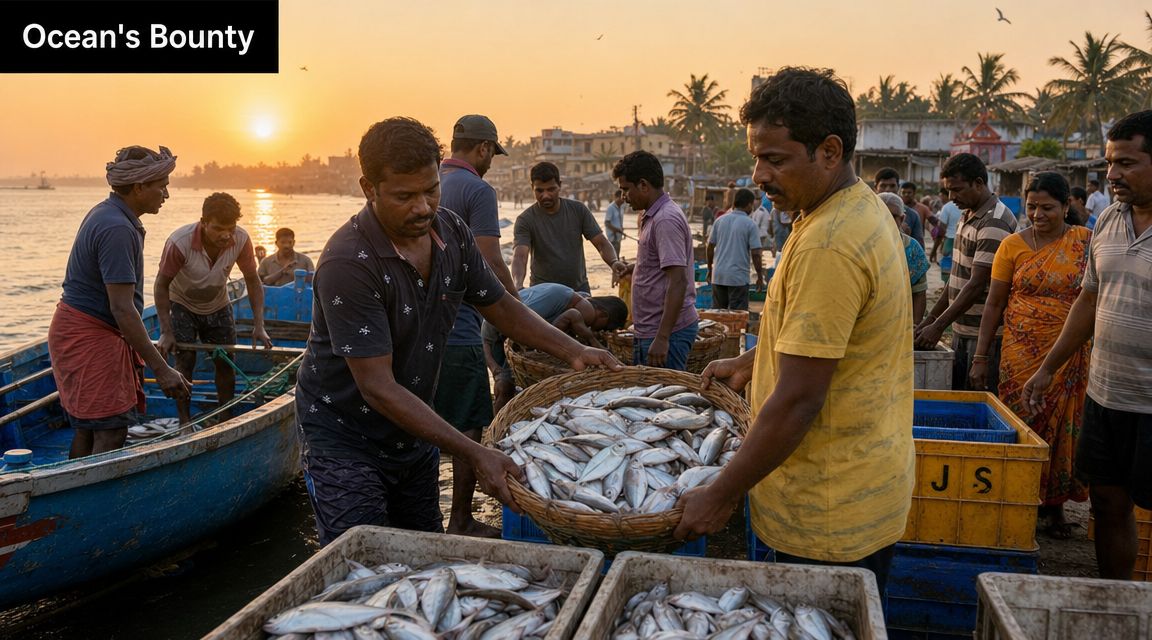
The verified evidence states that more than 3 billion people depend on the ocean for their livelihoods and as a primary source of protein, while the ocean also absorbs about 30% of human-produced carbon dioxide, as explained by the Woods Hole Oceanographic Institution. That pair of facts is especially important because it links household welfare to planetary stabilisation. The same system that feeds communities also helps buffer climate disruption.
Livelihoods, nutrition, and exposure
In many coastal economies, a change in ocean conditions is not only an ecological event. It is a labour-market shock and a nutrition shock. Small-scale fishers, processors, traders, and families along coastal supply chains often have limited buffers against declining catches, damaged habitats, or severe weather.
That has direct implications for the Sustainable Development Goals.
- Poverty reduction: Ocean-linked livelihoods support household income where alternatives may be limited.
- Hunger and nutrition: Marine protein is a core dietary input for many populations.
- Health and stability: When food and income become less predictable, public systems face more pressure.
The equity issue is decisive. Marine decline tends to punish communities with the least capacity to absorb volatility.
Why human wellbeing belongs in ocean governance
Ocean policy can become overly technical. It can drift into maps, zones, conventions, and satellite tracking. Those tools matter, but the policy objective is broader. Governments are managing access to food, work, and environmental security for people whose lives are tied to coastal ecosystems.
A short film captures that human dimension well:
The overlooked wellbeing function
Another underappreciated point is coastal protection. The verified evidence notes that oceans provide key natural resources, including food, while also buffering coastal areas from storm damage. For densely populated shores, that means marine ecosystems support safety as well as livelihoods.
This creates a governance obligation that is easy to miss. If states allow coastal ecosystems to degrade, they are not only losing biodiversity. They are weakening social protection by removing a layer of natural defence. The people hit first are usually those whose housing, income, and nutrition are already most precarious.
For multilateral institutions, ocean policy becomes a question of inclusive growth. A credible ocean agenda must connect conservation with livelihoods, social protection, and fair access to marine resources.
A New Arena for Geopolitical Competition
The ocean is a cooperative space in theory and a competitive space in practice. It carries trade, hosts strategic infrastructure, and contains valuable resources. That makes it central to power projection and national vulnerability at the same time.
The most concrete illustration from the verified evidence is the UK's dependence on maritime commerce. Roughly 95% of the UK's trade by volume moves by sea, which the US National Ocean Service highlights in its discussion of why the ocean matters. The UK is not unique in that reliance. It is a clear example of what maritime dependence looks like when expressed in national terms.
Trade routes as strategic exposure
Sea lanes are often discussed as commercial channels. They are also strategic chokepoints. If disruption affects a major maritime route, the consequences cascade into shipping costs, delivery times, energy flows, and industrial planning. Ministries of trade, defence, and finance all inherit the consequences.
This is why ocean policy increasingly overlaps with hard security.
- Trade security: States need open, predictable sea routes.
- Infrastructure security: Ports, undersea cables, and offshore assets are exposed.
- Resource security: Fisheries and seabed access can sharpen regional tensions.
Resource competition and contested waters
Competition over marine resources doesn't only concern extraction. It concerns jurisdiction, monitoring, and enforcement. Fisheries access, marine conservation zones, shipping rights, and offshore energy development all require boundaries, rules, and compliance capacity. In contested waters, those issues become proxies for broader geopolitical rivalry.
That's one reason maritime governance can't be treated as a technical silo. It intersects with alliance politics, regional deterrence, and strategic signalling. The wider pattern of international rivalry discussed in analysis of US and Russia relations is not an ocean article, but it illustrates the broader point that strategic competition routinely spills into domains once treated as functional or administrative.
When trade routes, energy infrastructure, and resource claims overlap in the same geography, marine governance becomes part of statecraft.
Climate risk as a security issue
There is also a slower-moving security dimension. Coastal infrastructure, naval facilities, and maritime communities all depend on a stable physical baseline. As that baseline shifts, defence and foreign ministries face new planning problems. The issue is not only warfighting. It is operational continuity, alliance logistics, humanitarian response, and the security of critical assets.
The ocean's geopolitical significance deepens here. It is not merely a space where states compete. It is a space whose changing physical condition alters the terms of that competition. Governments that fail to integrate ocean risk into security planning will find that their commercial, diplomatic, and defence strategies rest on unstable assumptions.
The Fractured State of Global Ocean Governance
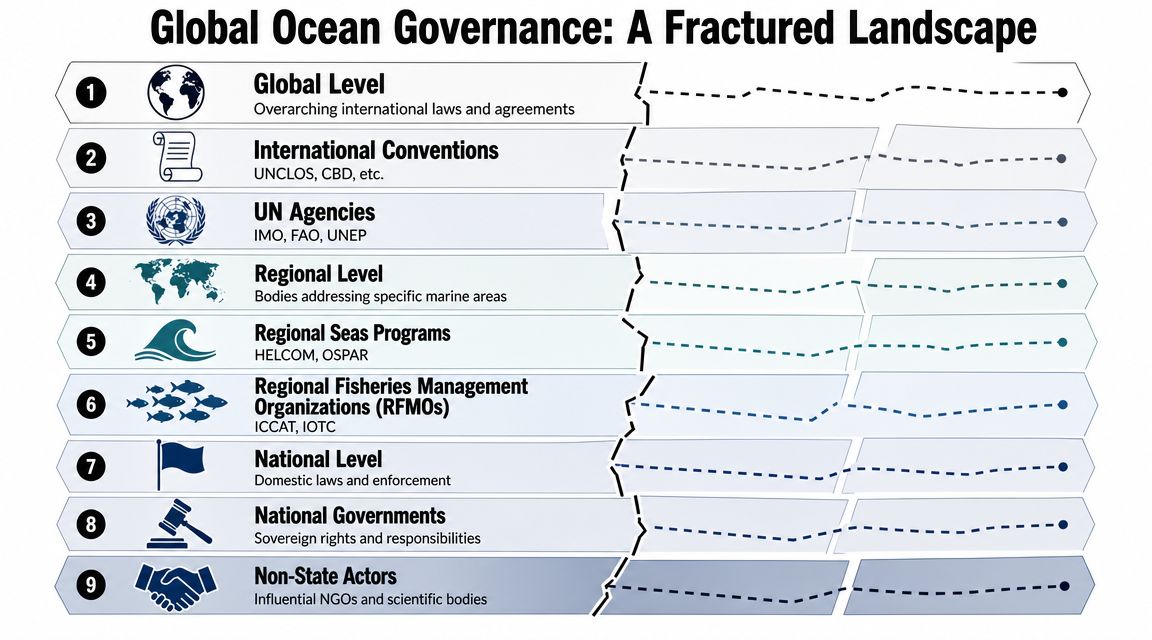
Ocean governance contains a central paradox. The world has rules, institutions, and regional bodies, yet outcomes often remain fragmented. The problem is not the complete absence of governance. It is the mismatch between ecological reality and institutional design.
The architecture is broad but uneven
At the centre sits the UN Convention on the Law of the Sea, which provides the foundational legal order for maritime zones, rights, and obligations. Around it sits a dense patchwork of institutions: the International Maritime Organization, regional fisheries bodies, regional seas arrangements, national regulators, coast guards, courts, and scientific networks.
That architecture matters, but it is difficult to coordinate. Marine ecosystems don't map neatly onto jurisdictions. Shipping, fishing, conservation, energy, and security agencies often pursue different mandates using different tools and timelines.
A governance system like this tends to produce three recurring problems.
- Enforcement gaps: Rules may exist without sufficient monitoring or compliance capacity.
- Financing gaps: States often commit in principle but underfund implementation.
- Jurisdictional gaps: Areas beyond national control are hard to regulate coherently.
Why fragmentation persists
Ocean governance is hard because it asks institutions to manage mobility. Fish move. Pollution moves. Heat moves. Ships move. Carbon moves. Yet legal authority is often territorially fixed and administratively segmented.
That creates an implementation problem even where legal principles are sound. A fisheries body may focus on stock management while a transport body focuses on navigation safety and a national ministry focuses on licensing revenue. Each may be rational on its own terms. Collectively, the result can still be ecological decline or political stalemate.
| Governance challenge | What it looks like in practice | Strategic consequence |
|---|---|---|
| Enforcement weakness | Limited ability to monitor and sanction harmful activity | Rules lose credibility |
| Institutional overlap | Multiple bodies govern the same space differently | Decisions become slow or inconsistent |
| High-seas complexity | Shared areas lack clear operational accountability | Collective action stalls |
The case for institutional coherence
A more coherent governance approach doesn't require replacing every existing body. It requires connecting mandates, finance, data, and accountability more effectively. In practice, that means better coordination between maritime law, biodiversity policy, fisheries management, and national planning.
The policy debate on collective action to protect our fisheries and oceans speaks directly to this challenge. Ocean governance fails less from lack of rhetoric than from weak alignment between actors with different authorities and incentives.
The core governance problem is not whether the world values the ocean. It is whether institutions can govern an interconnected marine system with tools that remain largely fragmented.
An Actionable Policy Agenda for the G7 and G20
G7 and G20 leaders don't need another aspirational statement about ocean stewardship. They need a limited set of actions that fit within existing summit practice, align with economic and security priorities, and can be implemented across ministries.
The most effective agenda is one that treats oceans as a shared systems challenge. That means combining climate policy, trade resilience, food security, and governance reform rather than negotiating each in isolation.
Four priorities that can move quickly
First, leaders should integrate ocean considerations more directly into national climate and adaptation planning. Marine systems are part of the climate system, so they belong inside the practical machinery of resilience planning, infrastructure strategy, and carbon management.
Second, G20 members should build stronger shared capacity for maritime transparency. That includes better data exchange, stronger monitoring cooperation, and more coordinated action against harmful or illegal activity at sea. The value is not only environmental. It strengthens trust in supply chains and maritime rules.
Third, summit economies should align ocean finance with long-term asset resilience. Public development banks, export credit institutions, and private investors can all reduce the mismatch between short-term extraction incentives and long-term ocean stability.
Fourth, leaders should support more coherent governance across national and regional bodies. The challenge is less about inventing new forums than about making existing ones work together around common priorities.
Key Ocean Policy Recommendations for G7/G20 Summits
| Policy Area | G7/G20 Action | Desired Outcome |
|---|---|---|
| Climate and adaptation | Integrate ocean risk and marine ecosystem value into national climate and resilience planning | Better alignment between mitigation, adaptation, and coastal protection |
| Maritime transparency | Expand cross-border data sharing and operational cooperation on harmful activity at sea | More credible enforcement and safer trade routes |
| Sustainable finance | Direct public and private capital toward ocean-positive infrastructure and ecosystem protection | Lower long-term risk in coastal and marine-dependent sectors |
| Governance coherence | Improve coordination among legal, environmental, fisheries, and transport institutions | Fewer policy conflicts and stronger implementation |
What distinguishes a serious ocean agenda
A serious agenda has three qualities.
- It is cross-ministerial: Finance, foreign affairs, energy, environment, and defence must all be involved.
- It is implementation-focused: Leaders should back monitoring, enforcement, and finance, not just declarations.
- It is equity-aware: Coastal and developing states need support that reflects their exposure and dependence.
The strategic case is now clear. Oceans regulate the physical environment, support major economic systems, protect vulnerable communities, and shape geopolitical risk. Multilateral forums won't solve every marine challenge at once. They can, however, stop treating the ocean as peripheral and start governing it as the shared infrastructure it is.
Global Governance Media helps decision-makers connect complex global risks to practical policy choices. Explore more analysis, summit-focused commentary, and expert perspectives at Global Governance Media.