


Byline: Dr Eleanor Markham, Senior Policy Analyst
If a finance minister can track inflation to decimal points and a central bank can model labour-market slack in real time, why do so many governments still treat gender equality as a rhetorical objective rather than a managed policy outcome?
That gap matters. G20 leaders don't lack statements of intent. They lack a disciplined way to diagnose where inequality sits, distinguish headline progress from structural weakness, and decide which intervention is most likely to move the underlying system. A gender equality index matters because it turns a politically broad ambition into something institutions can benchmark, interrogate and govern.
For global governance, that shift is practical rather than symbolic. Inclusive growth, labour supply, care systems, leadership pipelines and institutional legitimacy are all shaped by whether women and men participate in economies and public life on equal terms. Governments can't allocate resources well if they only monitor one visible symptom, such as pay. They need a composite view that captures outcomes and the conditions that produce them.
That is why composite measurement has become so important to policy design. The most useful indices don't merely rank countries. They identify bottlenecks, reveal trade-offs and create a common language across ministries that otherwise work in silos. For delegates dealing with growth, competitiveness, social cohesion and resilience, that makes the gender equality index less a niche social indicator than a strategic governance instrument.
A useful starting point is to treat gender measurement as part of the same policy architecture that underpins fiscal oversight and performance management. That is also the logic behind Progress for women means progress, which argues that equality outcomes should be understood as part of broader social and economic performance, not as a side agenda.
Table of Contents
- Introduction Why Measuring Gender Equality Matters for Global Governance
- Deconstructing the Gender Equality Index
- A Comparative Look at Major Global Indices
- The Index as a Strategic Policy Toolkit
- Analysing G7 and G20 Performance Trends
- Navigating the Limitations and Data Gaps
- The Future of Measuring Gender Equality and A Call for Action
Introduction Why Measuring Gender Equality Matters for Global Governance
How should G20 governments decide where gender policy will produce the highest return: labour market reform, childcare expansion, political representation, health access, or fiscal redesign? Without a shared measurement framework, that choice is often driven by political visibility rather than policy effect.
For global governance, measurement is not a technical side issue. It is part of how states set priorities, coordinate across ministries, and judge whether public spending is addressing causes or only symptoms. Gender inequality rarely appears in one institution at a time. It is reproduced across employment systems, tax and transfer design, unpaid care arrangements, education pipelines, financial access, and political decision-making. A government that tracks only one of those channels is likely to treat a system failure as a sector problem.
That is the practical value of a gender equality index. It turns a broad policy objective into a decision tool. Instead of asking whether a country is "pro-equality" in general terms, officials can ask a harder and more useful question: which constraints are holding back progress, which ministries control them, and which changes are realistic within the budget cycle?
This matters especially in the G7 and G20 context, where leaders are expected to connect social outcomes to productivity, resilience, demographic pressure, and institutional legitimacy. The case for measurement is therefore administrative as much as normative. Governments need a common frame that allows finance ministries, labour ministries, gender ministries, and heads of government to work from the same diagnosis. A well-designed index can provide that shared reference point, while also supporting peer comparison and public accountability. For a related argument on why inclusive growth is a governance issue rather than a niche social agenda, see why progress for women is a measure of wider economic progress.
Why governance systems need a common metric
Fragmentation is a recurring policy failure. Employment teams may focus on participation rates, treasury officials on tax incentives, social ministries on care provision, and executive offices on representation targets. Each of those areas matters, but isolated metrics produce isolated remedies.
A composite index helps governments align their analysis. It gives cabinet-level decision-makers a common baseline, shows whether progress is broad or concentrated in one domain, and reduces the risk of claiming success on the basis of the most favourable indicator in a given year.
Used properly, an index also improves sequencing. If unpaid care is constraining women's labour supply, training schemes alone will underperform. If representation improves while economic security stagnates, the political signal may be stronger than the lived outcome. The policy lesson is straightforward. Measurement should inform prioritisation, not public relations.
What leaders should be measuring for
The central task is to identify binding constraints. That requires more than observing headline gaps.
A useful framework distinguishes at least three policy functions:
- Outcome monitoring, such as observing disparities in pay, employment, or representation
- Driver analysis, such as examining care burdens, occupational segregation, legal barriers, or unequal access to assets
- System tracking, such as testing whether budgets, delivery institutions, and ministerial mandates are aligned with the stated objective
This distinction has direct consequences for decision-making. Outcome measures are often enough to justify action, but they are rarely enough to design it. Driver analysis is what helps officials choose between childcare expansion, pay transparency rules, transport access, social protection reform, or leadership pipelines. System tracking then shows whether those interventions are funded, coordinated, and sustained long enough to change outcomes.
Indices are therefore most useful when treated as dashboards for state capacity. They can guide strategic planning, shape intervention design, and support performance tracking across electoral cycles. They can also mislead if used as a league table without context. A country can improve its aggregate score while leaving major inequalities untouched within regions, income groups, or population subgroups. For G20 delegates, the policy implication is clear. Use the index to structure decisions, but never let the headline score replace sector analysis, administrative data, and distributional scrutiny.
Deconstructing the Gender Equality Index
What, precisely, does a Gender Equality Index measure, and what can it support in practice for ministers deciding where to intervene first?
At its best, the index is a policy instrument, not a branding exercise. It gives governments a structured way to convert scattered evidence on work, income, care, representation, health, and education into a single diagnostic framework. That matters because gender inequality rarely sits in one ministry. It cuts across labour markets, fiscal policy, social protection, transport, education systems, and political institutions.
Understanding the Score's Architecture
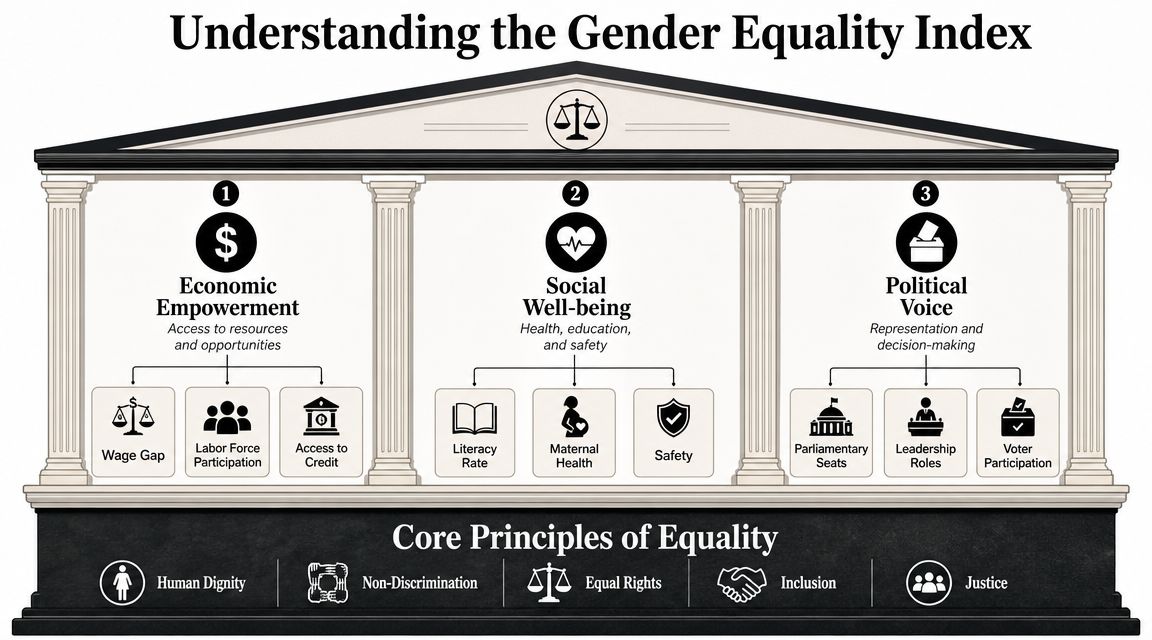
A composite index works by organising evidence in layers. In the European case, the EIGE Gender Equality Index uses a 1 to 100 scale and groups performance across domains including work, money, knowledge, time, power, and health, as noted in Equal Measures 2030's overview of the SDG gender index landscape. The headline score is only the entry point.
For policy use, three elements matter.
- Domains define the major policy arenas where inequality appears.
- Indicators translate those arenas into observable measures.
- Aggregation converts multiple measures into a standardised score that allows comparison across countries and over time.
This design serves two audiences at once. Senior officials get a concise overview of relative performance. Analysts get a structured basis for asking which domain is pulling national progress down, and whether the problem lies in labour-market access, time allocation, political representation, or another constraint.
That is why the internal structure matters more than the final number.
Why composite design changes the policy value of the index
The strongest indices do more than record visible outcomes. They also include enabling conditions that shape whether gains can last. In practical terms, that means a government can see whether better employment outcomes are being supported by changes in care arrangements, access to decision-making, or other institutional conditions, rather than treating each result as self-sustaining.
This distinction is especially important for G7 and G20 governments, where average national performance can obscure structural bottlenecks. A country may post respectable results in earnings or labour-force participation while still underperforming on unpaid care, leadership representation, or the distribution of time. In that situation, the aggregate score can suggest gradual progress even when the policy mix is too narrow to produce durable change.
A common example is increased female labour-market participation without a corresponding reduction in unpaid care burdens. The short-term signal looks positive. The medium-term pattern often does not. Promotion rates stall, part-time work becomes sticky, and senior representation remains weak because the underlying constraint was never addressed.
For decision-makers, the operational lesson is straightforward. Use the aggregate score to identify where to investigate. Use domain and indicator-level results to choose interventions, sequence reforms, and track whether policy is correcting the underlying imbalance.
The index is therefore most useful as a triage tool. It can show where pressure is building across the system. It cannot, on its own, explain every causal pathway or replace administrative, sectoral, and subnational analysis.
A Comparative Look at Major Global Indices
Which index should a finance minister trust when cabinet asks a simple question: where should we act first?
For G7 and G20 delegates, that question is more useful than any debate about the single "best" gender equality index. These tools were built for different decisions. Some are designed to compare countries at a glance. Others are better for showing welfare losses. A smaller set is useful for diagnosing which institutional domain is slowing progress and where public spending, regulation, or coordination should change.
That distinction matters in practice. A government can rank relatively well on a global index and still miss the policy mechanism behind weak outcomes. It can also perform poorly in a composite comparison while making real gains in areas that matter for medium-term growth, social protection, or representation. Analysts should therefore match the index to the policy task, not the other way around.
How policymakers should choose between indices
Three use cases recur in intergovernmental work.
The first is international benchmarking. Here, the priority is comparability across a large number of countries, often for summit communiqués, peer pressure, and public diplomacy. The second is welfare and development assessment, where the concern is how gender inequality reduces human development and social outcomes. The third is institutional diagnosis, where policymakers need to identify whether the binding constraint sits in work, income, time use, political representation, education, health, or another policy system.
The UK case illustrates the point in qualitative terms. In European comparisons, policymakers have relied on the EIGE Gender Equality Index as a standardised reference point, as noted earlier. Its practical value lies less in the headline rank than in the structured view it gives across multiple domains. That makes it more useful for administrative follow-through than a set of isolated labour-market indicators.
A minister reading a cross-country ranking gets a political signal. A minister reading a domain-based index gets a basis for prioritisation.
That is a different function.
Comparison of major gender equality indices
| Index | Primary Focus | Key Domains Covered | Best Use Case for Policymakers |
|---|---|---|---|
| World Economic Forum Global Gender Gap Index | Relative gender gaps in economic, educational, health and political participation | Broad cross-country gap comparison | International benchmarking and public diplomacy |
| UNDP Gender Inequality Index | Human development losses associated with gender inequality | Reproductive health, empowerment and labour-market participation | Development planning and welfare-oriented assessment |
| EIGE Gender Equality Index | Composite measurement of equality conditions and outcomes within a structured governance framework | Work, money, knowledge, time, power and health | Policy diagnosis, domain-level targeting and European comparability |
The table suggests a practical rule. Comparative indices are strongest when leaders want to know how their country performs relative to peers. Diagnostic indices are stronger when officials must decide what to change inside government systems.
This distinction becomes sharper in G20 settings, where communiqués often reward simple ranking logic but implementation depends on much finer analysis. If delegates want to identify reputational leaders or laggards, a broad global gap index is often sufficient. If they want to reduce barriers in hiring, care provision, leadership pipelines, or pay progression, they need an index that separates those problems rather than combining them into a single diplomatic headline.
That is also why index choice should be linked to the policy arena under review. Labour ministries assessing barriers to progression, for example, need more than an aggregate score. They need evidence that can be read alongside sector data, budget choices, and workplace regulation, including the wider workplace equality challenge that shapes whether gains in participation translate into advancement.
Used this way, the major indices are complementary rather than competing. One helps governments compare. Another helps them assess social loss. A third helps them identify where intervention is most likely to produce durable change.
The Index as a Strategic Policy Toolkit
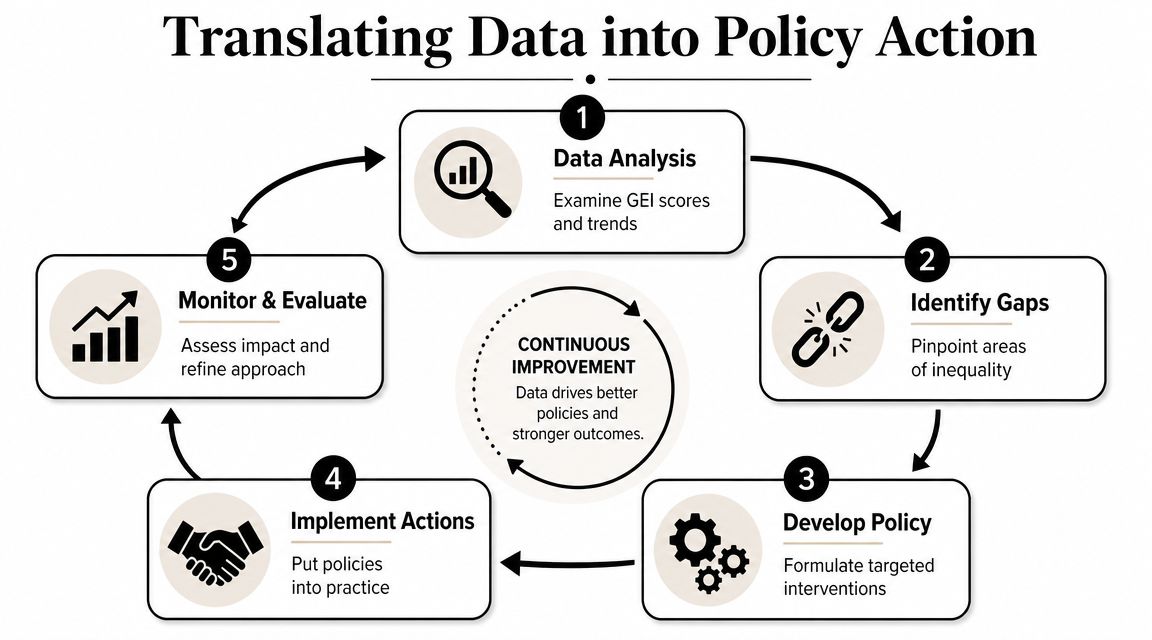
A gender equality index becomes valuable when governments treat it as part of the policy cycle rather than as a publication event. The sequence is straightforward. Diagnose. Target. Monitor. But each stage requires discipline.
A good policy team should begin with the composite result, then move quickly to the sub-domains and operational indicators beneath it. That is how an index shifts from advocacy to administration.
Diagnosis before intervention
The first task is to resist premature solutions. Many governments jump from a poor headline result to broad measures that look active but don't address the binding constraint.
A stronger approach uses a staged diagnostic:
- Start with the headline score: This establishes whether the country is underperforming in aggregate.
- Move to the weakest domain: A low result in time, work or power points to different policy systems.
- Interrogate the underlying indicators: In this step, analysts separate labour-market access problems from promotion bottlenecks, care constraints or representation failures.
That sequence prevents generic interventions. It also makes cabinet discussion more precise. A low score in leadership shouldn't trigger only an equal pay review. A weak result linked to care shouldn't be answered only with messaging campaigns.
A related workplace example exists in the UK. Statutory gender pay-gap reporting is not a full index, but it functions as a granular tool for intervention because the data can be decomposed by business unit, supporting actions such as promotion-pipeline audits, flexible-work redesign and pay-banding corrections, as described in this technical note on intervention-oriented reporting. That is the right logic for public policy too. Disaggregate before acting.
The same operating principle appears in the workplace equality challenge, which treats organisational data as a basis for redesign rather than compliance alone.
From indicator to action
Policy design improves when governments connect each weak area to a specific lever. Not every domain needs the same instrument.
Three policy moves tend to separate serious users of the index from superficial ones:
- Translate domain weakness into ministerial ownership. If unpaid care is suppressing labour-market outcomes, labour policy alone won't solve it.
- Set baseline-linked targets. Targets should be anchored to the measured weakness rather than announced independently of it.
- Review performance across political cycles. Composite metrics are especially useful when they outlast a single administration and preserve institutional memory.
Governments get better results when they treat the gender equality index as a management tool, not as a reputational product.
That approach also improves budget discipline. Spending becomes easier to justify when each intervention is tied to a diagnosed weakness and monitored against a recognised baseline.
Analysing G7 and G20 Performance Trends
Bloc-level analysis is attractive because it helps summit delegates convert dispersed national evidence into a shared agenda. But it has to be used carefully. G7 and G20 discussions often favour broad narratives about progress, while the underlying policy reality is far less uniform.
What a bloc-level reading can and cannot show
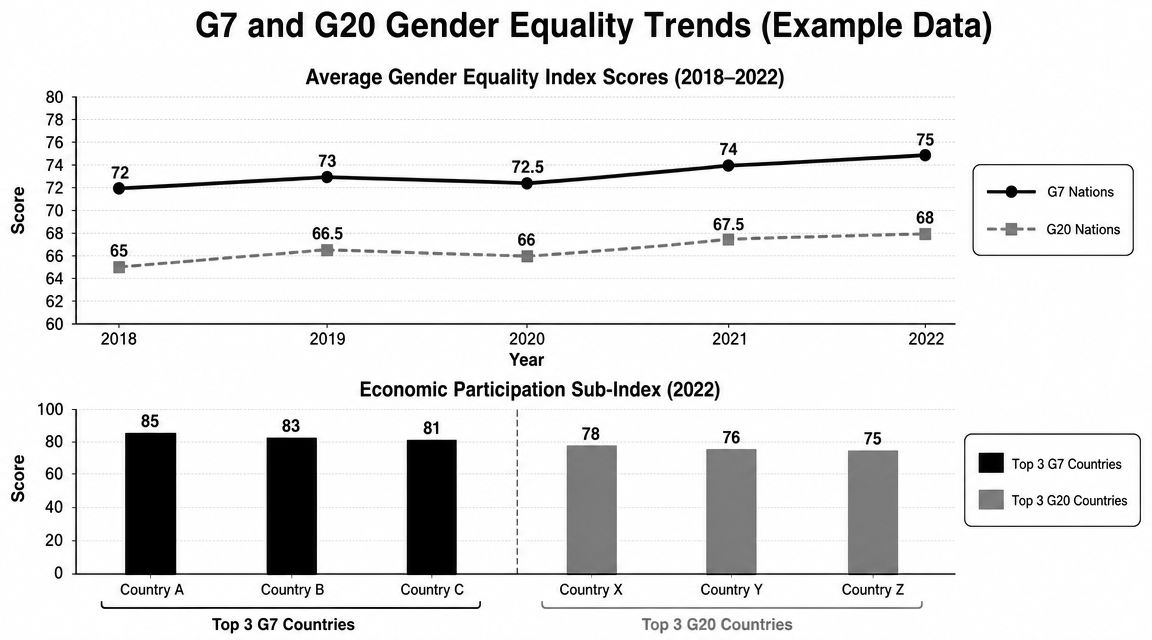
The most defensible reading is qualitative. Across advanced and emerging economies alike, the policy pattern is familiar. Governments often report visible gains in some formal domains while deeper constraints remain in care, senior leadership and the conditions that shape economic participation. That is why bloc conversations can become misleading if they rely on average performance alone.
A G7 or G20 lens is still useful because it helps identify common governance failures. If multiple countries struggle in domains linked to time use, leadership or labour-market structure, delegates can ask whether their policy mix is too narrow. They can also test whether summit commitments are over-weighted towards headline labour metrics and under-weighted towards enabling systems such as childcare, flexible work design and representation pathways.
Where summit agendas should focus
For G20 officials, the key value of trend analysis is agenda discipline. It helps separate three kinds of issue:
- Shared structural problems: areas where many countries face similar bottlenecks and can benefit from policy exchange.
- Country-specific constraints: weaknesses tied to local labour markets, institutions or social policy design.
- Measurement blind spots: outcomes that remain poorly captured in existing frameworks.
That distinction is central to multilateral usefulness. A summit declaration should not confine itself to celebrating broad commitment to equality. It should ask which dimensions of inequality continue to resist improvement, and why.
The strongest bloc discussions also avoid the trap of assuming that a respectable national average means broad-based progress. That issue has been raised in commentary on G20 performance on gender equality, where the central challenge is not only commitment but execution across very different institutional settings.
A bloc average can help frame diplomacy. It can't replace country-level diagnosis.
For delegates, that means trend analysis should inform peer learning and accountability, but not substitute for domestic policy design.
Navigating the Limitations and Data Gaps
Composite indices are useful because they simplify. They are risky for exactly the same reason. A national score can create an impression of coherence that the lived reality doesn't support.
National averages can conceal policy failure
The UK debate illustrates the point sharply. The key question for policymakers is whether national scores mask a weaker regional picture. The Equality and Human Rights Commission notes that progress is uneven across places, and country-level measures are often too coarse to show those internal gaps, as discussed in this analysis of uneven progress and place-based inequality. A country can therefore look acceptable in aggregate while women in some regions face much worse access to work, senior roles and affordable care.
That limitation matters beyond the UK. Large G20 economies all contain internal disparities shaped by geography, industrial structure, transport, care provision and local labour markets. A national index score is often least informative where regional inequality is greatest.
Why technical caution matters
There are at least three recurring risks in how governments use a gender equality index:
- Over-aggregation: A single score can obscure which domain is weak and which population is being left behind.
- Under-measurement: Areas such as unpaid care and informal work are harder to capture cleanly, even though they shape outcomes elsewhere.
- Indicator gaming: Institutions may optimise for visible metrics rather than address the structural arrangements producing them.
Those limitations don't make the index less valuable. They define the conditions under which it should be used responsibly. The right response isn't to abandon composite measurement. It's to pair it with regional analysis, administrative data and policy judgement.
The Future of Measuring Gender Equality and A Call for Action
The next frontier in gender measurement is not a single better score. It is a better measurement system. Policymakers need tools that are more timely, more granular and better able to capture intersecting forms of disadvantage without losing comparability.
The next generation of measurement
Several practical improvements are already clear from the weaknesses of current approaches. Governments need stronger subnational visibility, better capture of care and time use, and closer integration between national statistical systems and administrative datasets. They also need frameworks that preserve comparability while showing where broad averages hide severe local underperformance.
The future role of digital tools and analytics is promising, but the principle is simple. More frequent data is only useful if it improves decisions. Faster dashboards that repeat the same blind spots won't help ministers allocate resources better.
What G20 leaders should do now
G20 leaders don't need to wait for a perfect index. They can act on three immediate priorities.
First, they should require that gender metrics be embedded in mainstream economic planning rather than confined to specialist equality portfolios. Second, they should insist that national reporting be complemented by subnational analysis so that country averages don't conceal place-based failure. Third, they should support improvements to the measurement architecture itself, especially in areas where current systems understate care burdens, leadership barriers and intersecting disadvantage.
The core lesson is practical. What gets measured gets managed, but only if leaders use the metric to guide decisions, not just to describe aspiration. The gender equality index is already good enough to sharpen policy choices. The next task is to make it harder to ignore, easier to operationalise and more honest about what national averages miss.
Global governance works better when decision-makers share rigorous tools, comparable evidence and practical policy insight. Explore more analysis, summit coverage and expert perspectives at Global Governance Media and join the policy conversation on how gender measurement can drive stronger G7 and G20 decisions.