

By Elena Markham
The most surprising fact about climate change international agreements isn't that the world lacks a treaty framework. It's that the framework is already close to universal while the world remains materially off course. The Paris Agreement has been joined by 195 Parties and sets the shared objective of keeping warming “well below” 2°C while pursuing efforts to limit it to 1.5°C, according to the United Nations overview of the Paris Agreement. Yet the wider negotiating system still operates under intense pressure because, as the UNFCCC notes, keeping 1.5°C within reach requires global emissions to peak before 2025 and fall 43% by 2030, while current policies worldwide point to around 2.6°C of warming by 2100, as set out in the UNFCCC explanation of the Paris framework.
That contrast defines the diplomatic problem facing G7 and G20 leaders. The issue is no longer whether climate governance exists. It does. The issue is whether the operating system of climate diplomacy can still convert broad legal participation into faster policy delivery, credible finance, and enough trust to sustain cooperation.
For summit delegates, that means treaties shouldn't be read as symbolic texts. They should be read as instruments that allocate political pressure, shape domestic legislation, organise review cycles, and distribute expectations over who pays, who cuts, who adapts, and who bears residual loss. The practical question isn't “What agreement came after what?” It's “Which mechanisms still move state behaviour, and where are they breaking down?”
Table of Contents
- Introduction The Climate Diplomacy Paradox
- The Architectural Evolution of Climate Treaties
- Core Mechanisms Driving Global Climate Action
- The Pillars of Implementation Finance and Justice
- Assessing Performance Gaps and Political Realities
- A Forward-Looking Agenda for G7 and G20 Leaders
Introduction The Climate Diplomacy Paradox
Climate diplomacy now suffers from a paradox of maturity. The system is no longer thin, experimental, or marginal. It is structured, legal, repetitive, and embedded in national planning. But its very maturity has exposed a harsher truth. Consensus on procedure hasn't produced consensus on pace, burden-sharing, or cost allocation.
That matters most for the G7 and G20 because they sit at the centre of both sides of the equation. They shape most of the world's finance, industrial policy, and diplomatic signalling, and they also carry the burden of proving that climate commitments can survive electoral turnover, fiscal stress, and energy security shocks. When these economies hesitate, the entire treaty system slows down.
Practical rule: Read climate agreements less as environmental declarations and more as frameworks for economic coordination under political constraint.
For policymakers, the central task is to identify which treaty elements still generate movement. Some mechanisms create discipline. Others create transparency. Others create bargaining space between developed and developing economies. The quality of climate diplomacy depends on whether these mechanisms reinforce each other or cancel each other out.
Three points follow. First, the architecture has evolved from a narrow emissions regime into a universal governance model. Second, the Paris system works through cycles rather than one-off target setting. Third, the sharpest friction today sits around finance, fairness, and implementation credibility, not around treaty design alone.
The Architectural Evolution of Climate Treaties
From framework convention to implementation architecture
The history of climate change international agreements is often told as a sequence of conferences. That misses the more important point. These agreements form a layered institutional architecture.
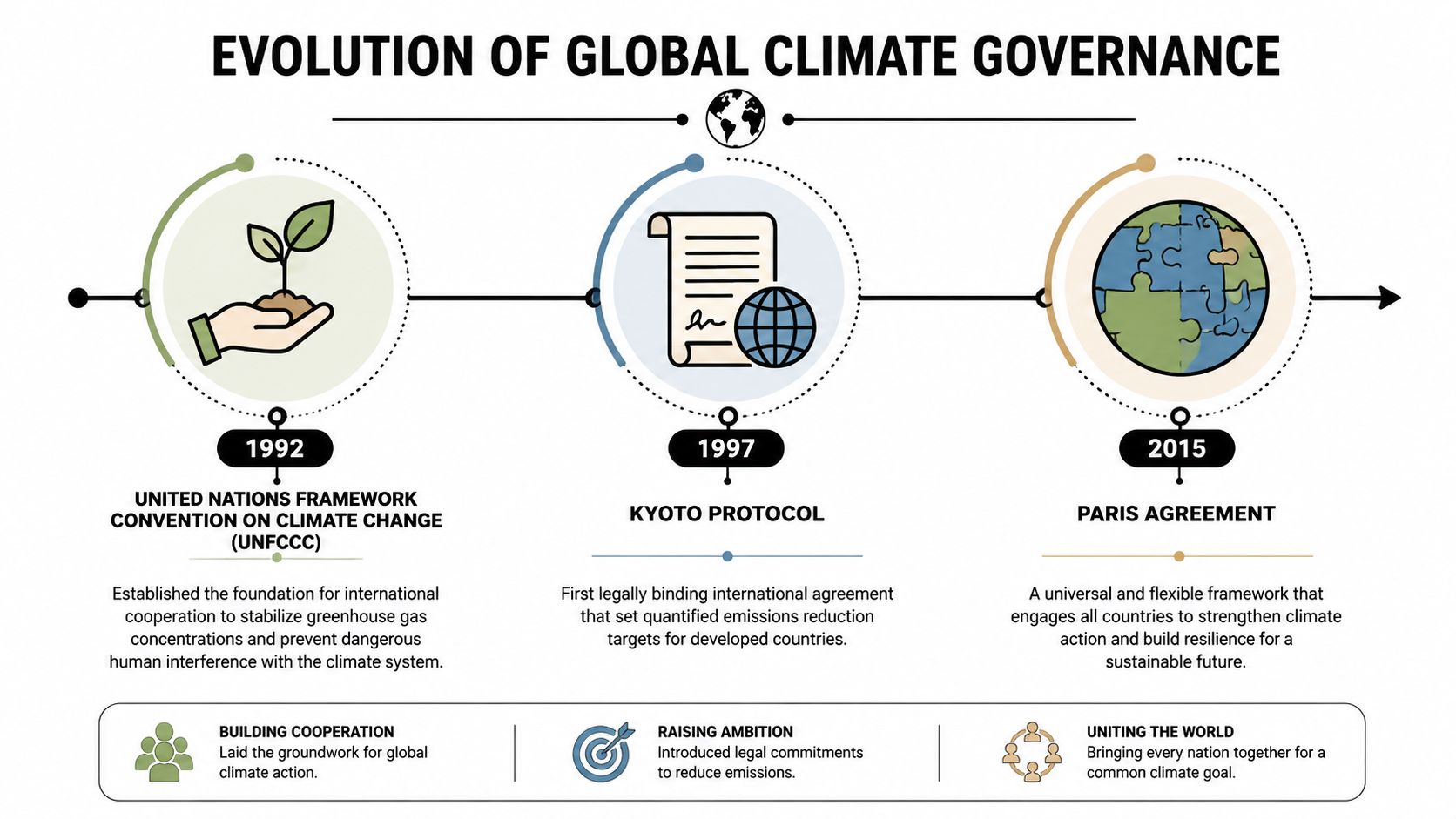
At the top sits the UNFCCC, the parent framework that established the long-run objective and the basic principles of climate cooperation. It created the forum, the vocabulary, and the expectation that states would keep negotiating rather than treat climate change as a one-off diplomatic event.
The next stage was the Kyoto Protocol, which used a more top-down model. Its logic was straightforward. Industrialised countries, seen as bearing the main historical responsibility and greater capacity, accepted binding targets while the broader system remained differentiated.
That structure had legal clarity, but it also had political limits. A treaty that binds only part of the world's economy can struggle when emissions growth, investment patterns, and industrial competition become more globally distributed.
Why Paris changed the political logic
The major shift came with the move from Kyoto to Paris. The UNFCCC explains this clearly. Kyoto imposed targets mainly on industrialised countries, while Paris introduced a universal system in which all countries submit nationally determined contributions, as outlined in the UNFCCC's Paris Agreement process page.
Paris changed the operating logic in three ways:
- Universal participation: All countries enter the system through nationally determined contributions, rather than only a defined subset taking on quantified obligations.
- Repeated cycles: Commitments aren't fixed once. They're expected to strengthen over time through review and resubmission.
- Political flexibility with legal structure: The treaty is legally binding in framework terms, but national contributions are nationally determined, which makes participation easier and withdrawal from action politically harder to justify.
A useful way to understand the transition is as a trade-off between precision and breadth. Kyoto offered more direct top-down constraint for a narrower group. Paris offered broader participation with stronger emphasis on iteration, transparency, and political escalation.
| Feature | Kyoto Protocol (1997) | Paris Agreement (2015) |
|---|---|---|
| Participation model | Primarily industrialised countries carried target obligations | All countries submit nationally determined contributions |
| Core design | Top-down targets | Bottom-up national pledges within a common framework |
| Diplomatic logic | Differentiate sharply by development category | Universal participation with evolving differentiation |
| Main accountability route | Compliance against fixed commitments | Repeated cycles of pledge, review, and strengthening |
That shift also changed what summit diplomacy needs to do. Under Kyoto, the argument centred on who should be bound. Under Paris, the argument centres on whether national pledges and supporting finance are credible enough to tighten over time. For a broader perspective on institutional redesign, see this analysis of towards a new international architecture.
Core Mechanisms Driving Global Climate Action
Paris functions as the operating system of climate diplomacy. Its influence comes from how national pledges, reporting rules, and review cycles interact to shape state behaviour, capital allocation, and diplomatic pressure.
NDCs as the political entry point
The central instrument is the Nationally Determined Contribution, or NDC. An NDC is more than a formal pledge filed under a treaty. It is the point where international obligation meets domestic political economy.
That distinction is especially important for G7 and G20 governments. An NDC affects energy planning, industrial strategy, transport policy, land use, adaptation spending, and fiscal choices. It also sends signals to regulators, export sectors, investors, and trading partners about the direction of national policy.
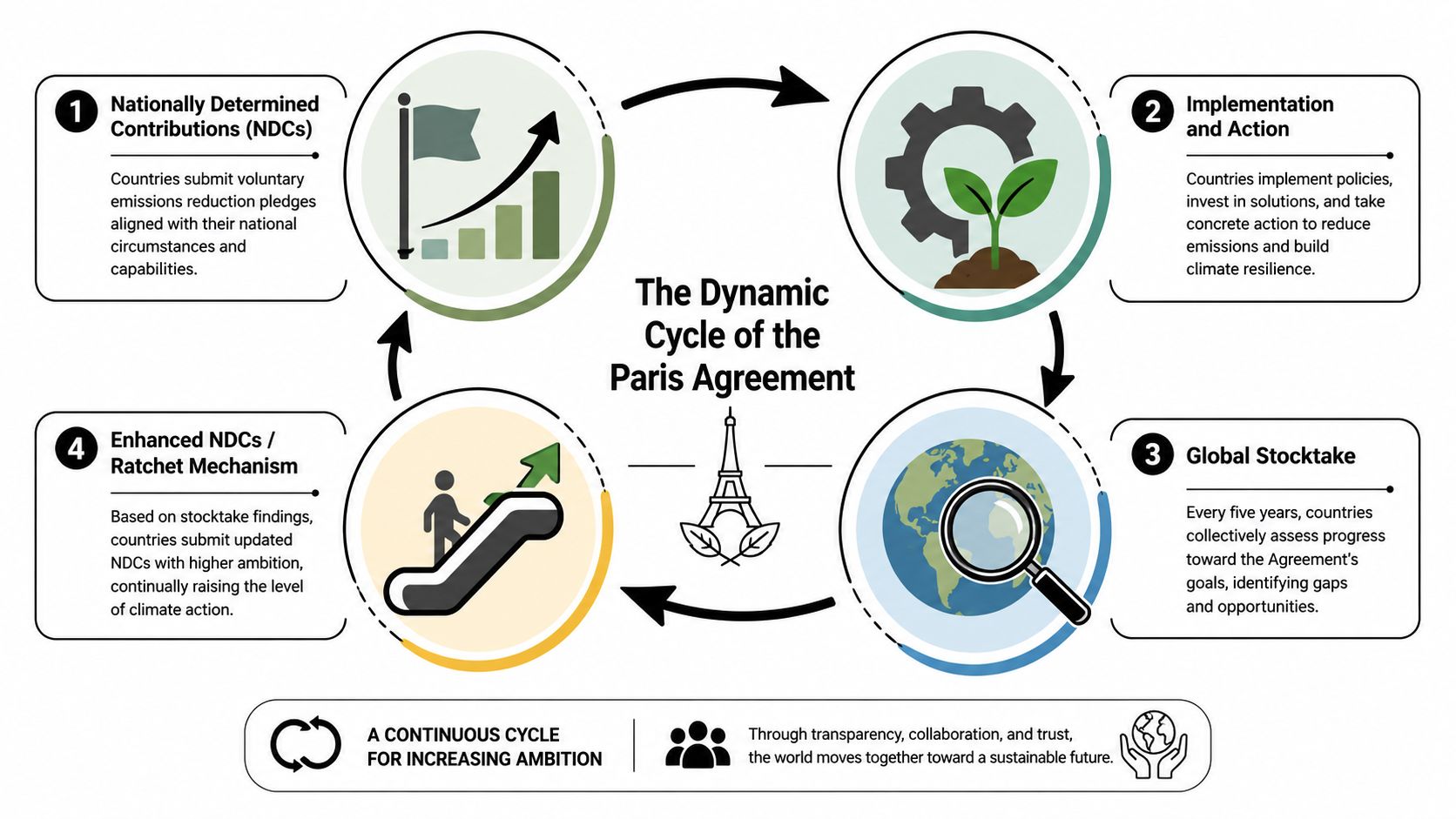
As noted earlier, the Paris framework operates through recurring five-year cycles in which countries are expected to update and strengthen their contributions. The cycle's importance lies in preventing climate policy from being frozen at the ambition level of a single negotiating moment. It creates repeated decision points, which gives diplomacy continuing relevance after the summit communiqué is issued.
A short explainer clarifies why NDCs carry so much weight:
- NDCs are nationally set. Governments choose the scope, timing, and sector coverage.
- They are internationally registered. Other states, investors, and civil society can compare commitments across countries.
- They shape credibility. A government that files a pledge without domestic delivery invites scrutiny at home and abroad.
- They influence bargaining power. Stronger or clearer NDCs can improve a country's position in trade, finance, and coalition-building discussions.
Later in the same system, implementation questions become unavoidable. This video gives a concise overview of how the Paris process works in practice.
The cycle that creates pressure
Paris is designed to keep governments returning to the table.
The sequence is straightforward:
- Countries submit NDCs.
- They implement domestic measures.
- Collective progress is assessed.
- Governments return with stronger pledges.
This is commonly described as the ratchet mechanism. In practice, it works less through formal sanction than through recurring comparison. Each round forces governments to explain why their contribution is aligned, delayed, or weaker than that of peers with similar capabilities.
That design has a practical political effect. It shifts the main argument from whether climate action should occur to whether a government's offer is credible relative to science, competitors, and declared net-zero goals.
Repetition is the system's main source of pressure. Repetition alone does not produce stronger outcomes unless domestic policy, diplomatic coordination, and financial support reinforce each other.
A second mechanism, the Enhanced Transparency Framework, is quieter but no less important. Common reporting rules create a shared factual baseline for emissions, progress, and support. Without that baseline, negotiations drift into procedural dispute and selective accounting. With it, disagreement remains, but the room for ambiguity narrows.
For G7 and G20 delegates, this has direct strategic implications. The test is not whether leaders endorse ambitious language at a summit. The test is whether major economies return home with instructions to revise NDCs, align sector policy, publish credible data, and defend those choices in the next review cycle. That is how the machinery of climate diplomacy converts treaty text into pressure on real economies.
The Pillars of Implementation Finance and Justice
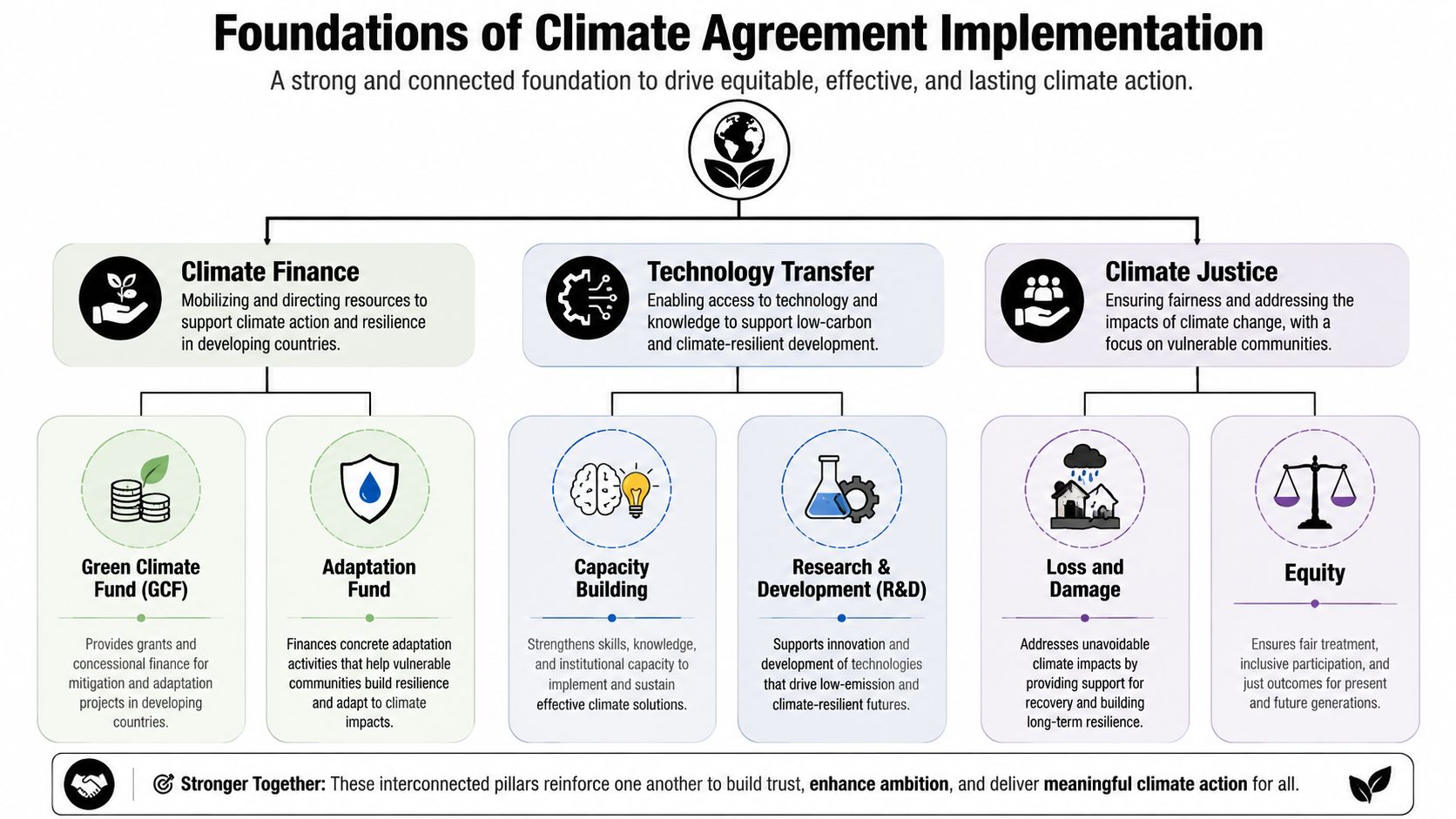
No climate agreement works on pledges alone. It works when finance, technology access, and political legitimacy support those pledges. That's why implementation debates have become the hardest part of the post-Paris order.
Finance as credibility not charity
The most consequential misunderstanding in climate diplomacy is to treat finance as an auxiliary issue. It isn't. Finance is part of the deal structure.
Research discussed in this analysis of the climate finance gap and ambitious action sits squarely within a wider reality identified in the academic literature. Trust within international climate agreements is severely strained by financial shortfalls, and developed countries face continuing criticism for not fully meeting historic finance pledges, according to this peer-reviewed assessment of fairness and finance debates.
For G7 economies, this creates a strategic problem. They often frame climate leadership around domestic targets and innovation policy, but many negotiating partners judge credibility through delivery on international support. In other words, diplomatic trust depends less on speechmaking than on whether support for adaptation, resilience, and transition is perceived as real, timely, and fair.
A practical reading of finance has three dimensions:
- Mitigation finance: capital for decarbonisation and energy transition.
- Adaptation support: resources for resilience where impacts are already unavoidable.
- Institutional confidence: proof that developed countries will honour the cooperative bargain embedded in the wider regime.
Loss and damage as the test of political trust
The second pressure point is loss and damage. This isn't merely another funding window. It is the most politically charged expression of climate justice in current negotiations.
The same peer-reviewed source notes that loss-and-damage compensation remains politically contested and that the post-Paris model is shifting from a narrow focus on emissions targets toward a broader bargain over resilience and transition finance. That shift matters because it changes what developing countries expect from major economies. They are no longer judging the regime only by mitigation ambition. They are judging it by whether it addresses harms already unfolding.
Negotiating implication: when developed countries separate mitigation from fairness, many partners hear a refusal to engage the full reality of climate risk.
Technology transfer and capacity building sit between these poles. They receive less public attention than headline finance disputes, but they are essential to implementation. States can't decarbonise at pace if they lack technical capability, institutional capacity, or access to deployable solutions. For G20 leaders, industrial strategy and development cooperation now intersect directly within climate diplomacy.
Assessing Performance Gaps and Political Realities
The standard question is whether the climate regime is working. The better question is which parts are working, which parts are stalled, and why the system keeps reproducing ambition that outpaces implementation.
The emissions gap is only one gap
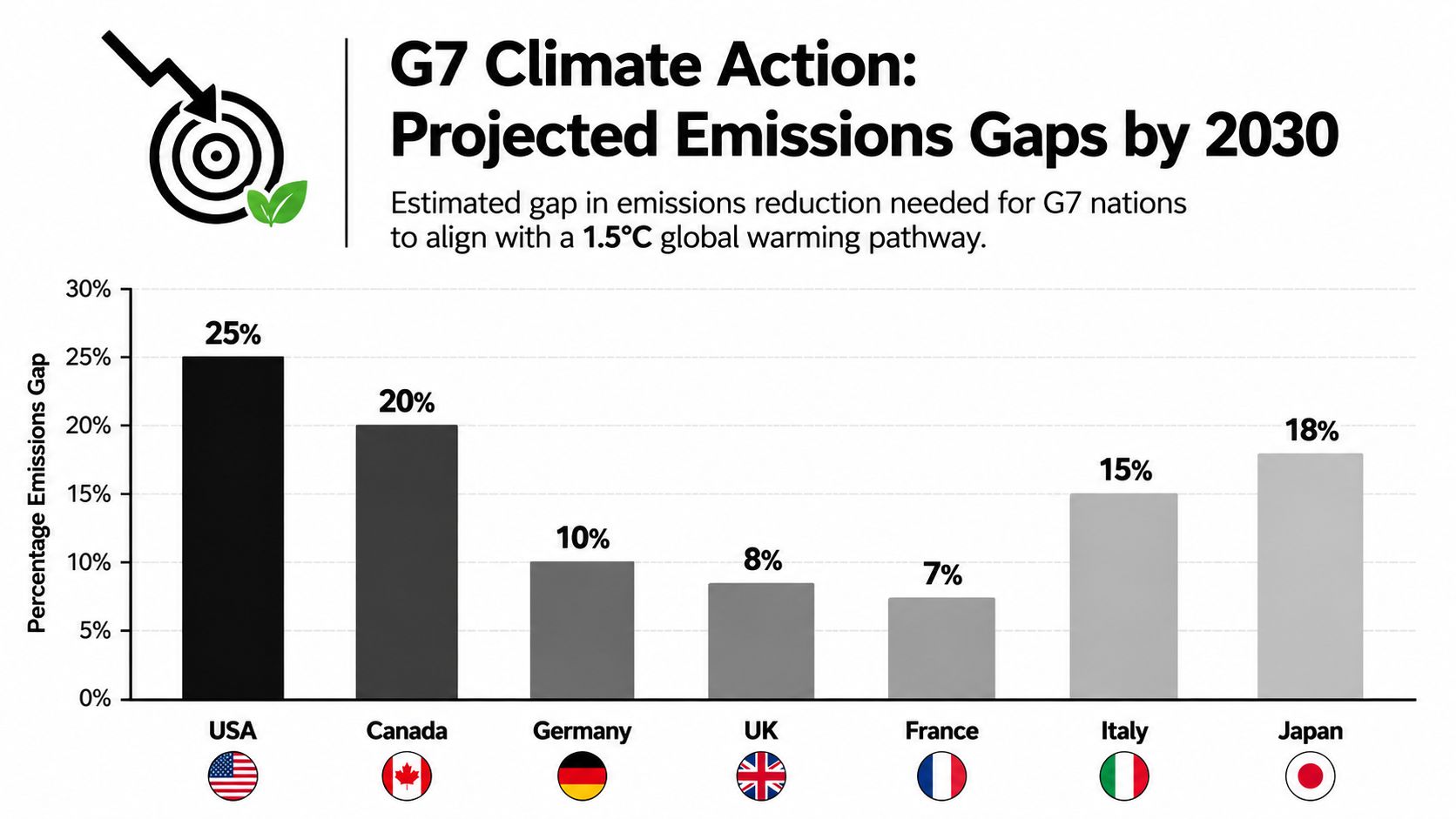
The most cited shortfall is the emissions gap. The underlying reality was already noted earlier through the Paris science-policy benchmark: the world needs much faster emissions decline than current policy pathways imply. But emissions are only the visible symptom.
There are at least three separate gaps that G7 and G20 delegates should track.
- Ambition gap: what governments say internationally may still fall short of what the temperature goal requires.
- Implementation gap: domestic law, spending, regulatory design, and political follow-through often lag behind the pledge.
- Trust gap: countries that depend on external support question whether the system is operating on fair terms.
These gaps interact. Weak implementation in major economies undermines confidence in future rounds of ambition. Weak finance delivery makes developing countries less willing to accept tighter expectations. Weak trust then feeds back into weaker diplomacy.
A candid policy reading is that the Paris system hasn't failed because it lacks procedural sophistication. It struggles because procedural sophistication can't substitute for political settlement on cost-sharing.
Why G7 and G20 politics keep the system stuck
The G7 and G20 matter because they are where climate policy collides with all the things leaders think about first. Inflation. Industrial competitiveness. Fiscal space. Security of supply. Electoral backlash. Trade exposure. Those constraints don't sit outside climate diplomacy. They define it.
That's why the hardest negotiations now aren't really about atmospheric science. They're about political economy. Which industries move first. Which countries receive support. Whether public finance de-risks private capital. Whether trade policy accelerates clean deployment or fragments it. Whether strategic competition blocks coordination.
A few realities follow from this:
| Political reality | Diplomatic consequence |
|---|---|
| Domestic coalitions are fragile | Governments avoid commitments they fear they can't implement |
| Finance promises shape negotiating trust | Developing countries link mitigation cooperation to support delivery |
| Energy security shocks alter priorities | Leaders may slow or re-sequence transition policies |
| Industrial policy is back | Climate diplomacy increasingly overlaps with competition policy and trade |
The result is a regime that is simultaneously strong and vulnerable. Strong, because almost every government now has to operate within the Paris vocabulary of pledges, review, and rising ambition. Vulnerable, because the pace of actual delivery depends on domestic political choices the treaty itself cannot command.
The central weakness of climate change international agreements isn't legal emptiness. It's that they rely on governments to repeatedly choose long-term collective gain over short-term political caution.
That diagnosis leads to a sharper conclusion for summit diplomacy. Leaders shouldn't treat COP outcomes and G7 or G20 communiqués as separate theatres. They are part of one credibility chain. If summit processes don't help governments solve financing, implementation, and fairness disputes, they merely recycle ambition language while the underlying bargain erodes.
A Forward-Looking Agenda for G7 and G20 Leaders
The next phase of climate diplomacy won't be won by adding more rhetoric to an already crowded system. It will be won by restoring confidence that the operating system can still produce delivery.
What leaders should do next
First, G7 and G20 governments should treat the next round of NDCs as cabinet-level economic strategies, not environment ministry submissions. That means aligning energy, industry, transport, fiscal, and foreign policy decisions before pledges are tabled. Weakly integrated NDCs create future implementation crises.
Second, leaders should move finance from the margins of summit text to the centre of negotiation strategy. Finance isn't a concession to secure goodwill. It is the mechanism that keeps broader participation politically viable. A country that wants stronger global ambition must also help build the conditions that make stronger ambition feasible.
Third, major economies should use smaller coalitions where universal consensus is too slow. Sectoral arrangements, coordinated standards, and practical cooperation among willing states can accelerate delivery without displacing the UN process. The G20 climate action agenda outlined here is one example of how summit forums can connect high politics to implementable measures.
Fourth, governments should rebuild trust through visible follow-through. In practical terms, that means fewer vague promises and more decisions that partners can verify through budget lines, institutional support, and diplomatic consistency. Tools that track commitments and summit outcomes, including publications such as Global Governance Media, can support that accountability function when used alongside official multilateral reporting.
Finally, leaders should stop assuming that climate diplomacy can remain compartmentalised. It now sits inside trade, development, industrial policy, and geopolitical alignment. The countries that recognise this early will shape the next phase of the regime. Those that don't will keep negotiating in climate language while making contradictory decisions elsewhere.
The strategic choice is straightforward. G7 and G20 leaders can continue managing climate agreements as recurring diplomatic ceremonies, or they can treat them as the governing framework for economic transition under conditions of shared risk. Only the second approach has any chance of preserving the credibility of the Paris era.
Global Governance Media helps policymakers, analysts, and summit delegates track the choices that define multilateral climate action. Explore more briefings, commentary, and cross-summit analysis at Global Governance Media.